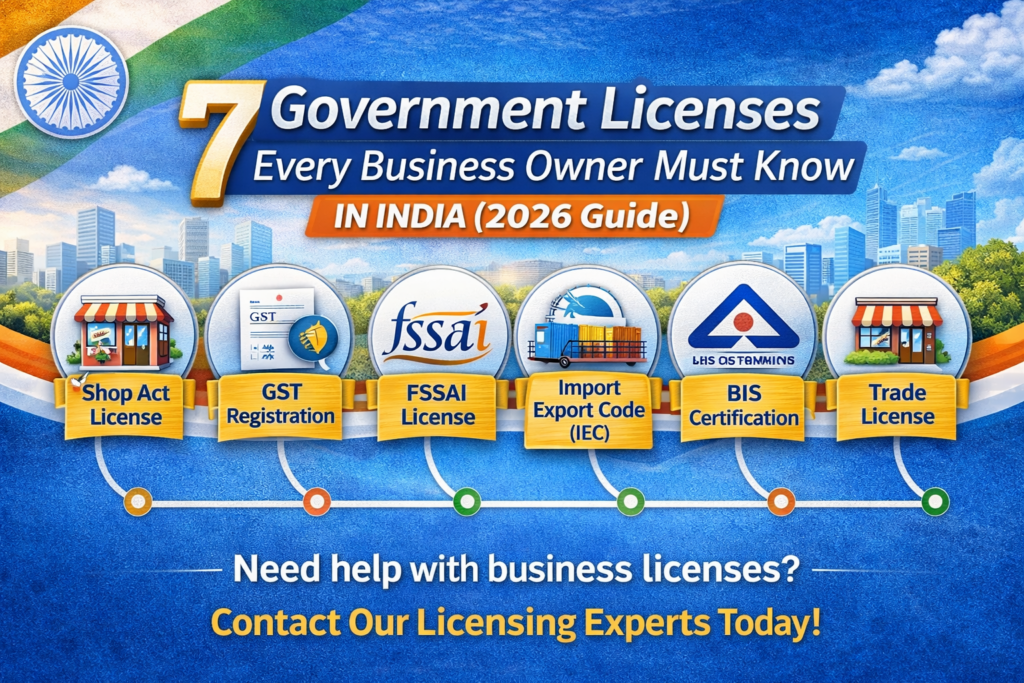
7 Government Licenses Every Business Owner Must Know in India (2026 Guide)
Starting a business in India is an exciting journey, but it also comes with several legal responsibilities. One of the most important aspects of running a business legally is obtaining the required government licenses and registrations. These licenses ensure that your business complies with government regulations and operates without legal issues. Many new entrepreneurs are unaware of the licenses required for their business. This lack of awareness can lead to penalties, legal complications, or even business closure. In this article, we will discuss 7 government licenses every business owner must know before starting a business in India.
Certification & Licensing
Trademark
Startup
Income Tax
Compliance
Certification & Licensing
Trademark
Startup
Income Tax
Compliance
The Shop and Establishment License, commonly known as the Shop Act License, is one of the most important registrations for businesses operating in India.
This license is regulated by the state government and is mandatory for businesses such as:
Retail shops
Offices
Restaurants
Service centers
Commercial establishments
The license regulates working hours, employee conditions, wages, and other workplace policies
government licenses for business in India
Legal recognition for your business
Required for opening a current bank account
Helps maintain employee records
Most states require businesses to apply for the license within 30 days of starting operations.
Goods and Services Tax (GST) is a mandatory registration for businesses involved in selling goods or services beyond a certain turnover limit.
Businesses must register for GST if their annual turnover exceeds:
₹40 lakh for goods
₹20 lakh for services
GST registration allows businesses to collect tax from customers and claim input tax credit.
Legal authorization to collect GST
Ability to sell products across India
Improves business credibility
Without GST registration, businesses may face penalties and restrictions.
If your business deals with food manufacturing, packaging, storage, distribution, or selling, obtaining an FSSAI License is mandatory.
The Food Safety and Standards Authority of India (FSSAI) regulates food safety and ensures that food products meet quality standards
government licenses for business in India
Businesses that require FSSAI include:
Restaurants
Food manufacturers
Cloud kitchens
Food delivery businesses
Food retailers
Basic Registration
State License
Central License
The type of license depends on the scale of your food business.
Businesses planning to import or export goods must obtain an Import Export Code (IEC) from the Directorate General of Foreign Trade (DGFT).
IEC is a 10-digit code required for international trade transactions.
Required for importing goods into India
Required for exporting products internationally
Needed for customs clearance
Without IEC, businesses cannot legally conduct international trade
government licenses for business in India
The Bureau of Indian Standards (BIS) certification ensures that products meet Indian quality and safety standards.
Many products in India require mandatory BIS certification before being sold in the market.
Examples include:
Electronics
Toys
Electrical appliances
Steel products
ISI Mark Certification
BIS CRS Registration
Obtaining BIS certification improves product credibility and ensures compliance with government safety standards.
MSME registration, also known as Udyam Registration, is for small and medium-sized businesses.
Although it is not mandatory, it provides several benefits to businesses.
Government subsidies
Lower interest rates on loans
Protection against delayed payments
Access to government tenders
Startups and small businesses can significantly benefit from this registration.
A Trade License is issued by the local municipal authority and allows businesses to operate within a specific area.
This license ensures that the business complies with local safety guidelines and does not create public health hazards.
Businesses that require a trade license include:
Manufacturing units
Restaurants
Retail stores
Service providers
Operating a business without a trade license may lead to penalties or legal action.
Government licenses are essential for maintaining legal compliance and protecting both businesses and consumers.
Here are some key reasons why licenses are important:
They ensure legal business operations
They build trust with customers and authorities
They prevent legal penalties and fines
They improve business credibility
Having the correct licenses allows businesses to grow smoothly without regulatory issues.
Starting a business in India requires proper planning and compliance with government regulations. Understanding the licenses required for your business is essential to avoid legal complications
government licenses for business in India
The 7 government licenses every business owner must know include:
Shop and Establishment License
GST Registration
FSSAI License
Import Export Code (IEC)
BIS Certification
MSME Registration
Trade License
Each license serves a specific purpose and ensures that businesses operate legally and safely.
If you are planning to start a business or need assistance with licensing and registrations, professional guidance can make the process faster and hassle-free.
Need help with business licenses?
Our experts can assist you with Shop Act License, BIS Certification, FSSAI Registration, IEC Code, and other government approvals.
📞 Contact us today to get started.
Lincenzo is a trusted business compliance and legal services platform, helping startups, MSMEs, and enterprises simplify registrations, certifications, licenses, and regulatory compliance with expert guidance and end-to-end support.