Top 10 Licenses Required to Start a Business - in India
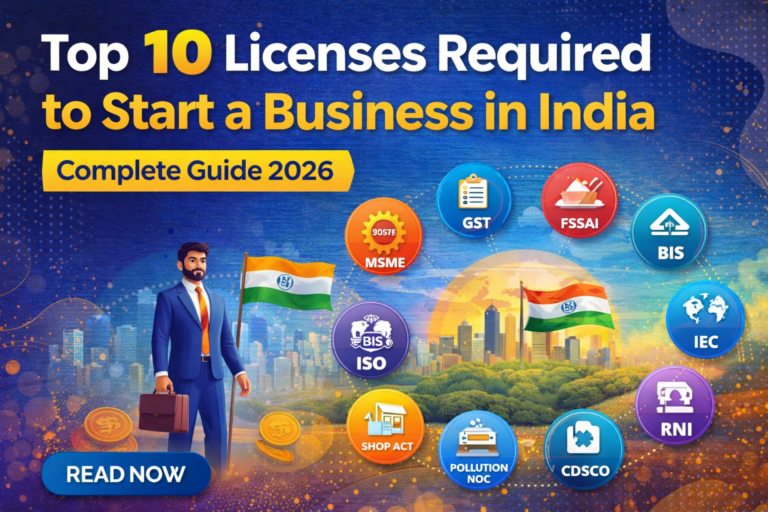
Starting a business in India is an exciting journey, but before launching your products or services, it is important to understand the legal requirements involved. The Government of India requires certain registrations and licenses to ensure businesses operate legally and maintain quality standards. Whether you are starting a startup, manufacturing unit, food business, or import-export company, having the correct licenses will help you avoid penalties and build credibility with customers and authorities. In this blog, we will explore the top 10 licenses required to start a business in India and why they are important.
Certification & Licensing
Trademark
Startup
Income Tax
Compliance
Certification & Licensing
Trademark
Startup
Income Tax
Compliance
Udyam Registration is one of the most important registrations for small and medium businesses in India. It is issued by the Ministry of Micro, Small and Medium Enterprises (MSME).
This registration helps businesses gain official recognition as an MSME and provides access to various government schemes and benefits.
Benefits of Udyam Registration:
Access to government subsidies and schemes
Easier approval of business loans
Protection against delayed payments
Priority in government tenders
This registration is especially beneficial for startups and small businesses looking to grow licenses required to start a business in India.
GST (Goods and Services Tax) registration is mandatory for businesses whose turnover exceeds the prescribed threshold or those involved in interstate trade.
GST registration allows businesses to legally collect tax from customers and claim input tax credits.
Businesses that require GST registration include:
E-commerce sellers
Service providers
Manufacturers and traders
Import-export businesses
GST registration also increases business credibility and enables smooth tax compliance.
If you are planning to start a food-related business such as a restaurant, food processing unit, bakery, cloud kitchen, or packaged food brand, obtaining an FSSAI license is mandatory.
The Food Safety and Standards Authority of India regulates food businesses to ensure safety and hygiene standards licenses required to start a business in India.
Types of FSSAI Licenses:
This license ensures that food products are safe for consumption and comply with government regulations.
A Shop and Establishment License is required for businesses operating in shops, offices, retail outlets, or commercial establishments.
This license is issued by the respective state government and regulates working conditions such as employee rights, working hours, and wages.
Almost every business with a physical office or shop requires this license licenses required to start a business in India.
If your business involves importing or exporting goods or services, you must obtain an Import Export Code (IEC) from the Directorate General of Foreign Trade (DGFT).
This license is essential for international trade and enables businesses to expand globally.
Benefits of IEC License:
Enables global business expansion
Required for import and export transactions
Access to export incentives and government schemes
Without an IEC code, businesses cannot legally conduct import-export activities.
The Bureau of Indian Standards (BIS) certification ensures that products meet the required quality and safety standards in India.
Certain products such as electronics, appliances, cement, and steel require mandatory BIS certification before they can be sold in the Indian market.
Benefits of BIS Certification:
Ensures product safety and quality
Builds consumer trust
Required for selling certain regulated products
Businesses manufacturing regulated products must obtain BIS certification to operate legally licenses required to start a business in India.
ISO certification is an international standard that demonstrates a company’s commitment to quality, efficiency, and safety.
Although ISO certification is not always mandatory, it significantly improves business credibility and trust.
Popular ISO Certifications include:
Many companies obtain ISO certification to improve their reputation and attract more clients.
Businesses involved in manufacturing, production, or industrial operations may require a Pollution Control No Objection Certificate (NOC) from the State Pollution Control Board.
This certificate ensures that the business follows environmental guidelines and does not harm the environment.
There are two types of approvals:
Consent to Establish
Consent to Operate
Environmental compliance is becoming increasingly important for businesses in India licenses required to start a business in India.
Companies dealing with cosmetics, pharmaceuticals, and medical devices must obtain approval from the Central Drugs Standard Control Organization (CDSCO).
This registration ensures that medical and cosmetic products meet safety and quality standards before entering the Indian market.
Businesses importing cosmetics or medical devices must obtain CDSCO approval before selling their products.
If you are planning to start a newspaper, magazine, or publication, you must obtain registration from the Registrar of Newspapers for India (RNI).
This license provides legal authorization to publish newspapers or periodicals in India.
RNI registration is mandatory for media businesses involved in print publishing.
Obtaining the necessary licenses and registrations is crucial for any business. These licenses help ensure legal compliance and protect businesses from penalties or legal issues.
Key benefits of business licenses include:
Legal recognition and compliance
Improved credibility and trust
Access to government schemes and subsidies
Smooth business operations
Without proper registrations, businesses may face fines, legal actions, or operational restrictions.
Starting a business in India requires careful planning and compliance with government regulations. The licenses mentioned above are among the most important registrations required to operate legally and successfully.
Whether you are launching a startup, manufacturing unit, food business, or import-export company, obtaining the right licenses will help you build trust and grow your business smoothly.
If you are unsure about which licenses your business requires, it is always best to consult professionals who can guide you through the process.
Getting the right licenses at the beginning will save time, avoid legal complications, and ensure long-term business success.
Lincenzo is a trusted business compliance and legal services platform, helping startups, MSMEs, and enterprises simplify registrations, certifications, licenses, and regulatory compliance with expert guidance and end-to-end support.