Government Licenses Every Manufacturer in India Should Know About in 2026
Starting a manufacturing business in India involves much more than setting up machinery and beginning production. Manufacturers need to consider various registrations, licences, certifications, tax requirements and environmental approvals depending on their products, location and business activities. Having the right approvals in place can help a business operate legally, build credibility and avoid unnecessary compliance problems. However, not every manufacturer needs every licence. Requirements depend on the nature of the product, manufacturing process, location and applicable government regulations. In this guide, we explain some of the important registrations and approvals that manufacturers in India should know about in 2026.
Certification & Licensing
Trademark
Startup
Income Tax
Compliance
Certification & Licensing
Trademark
Startup
Income Tax
Compliance
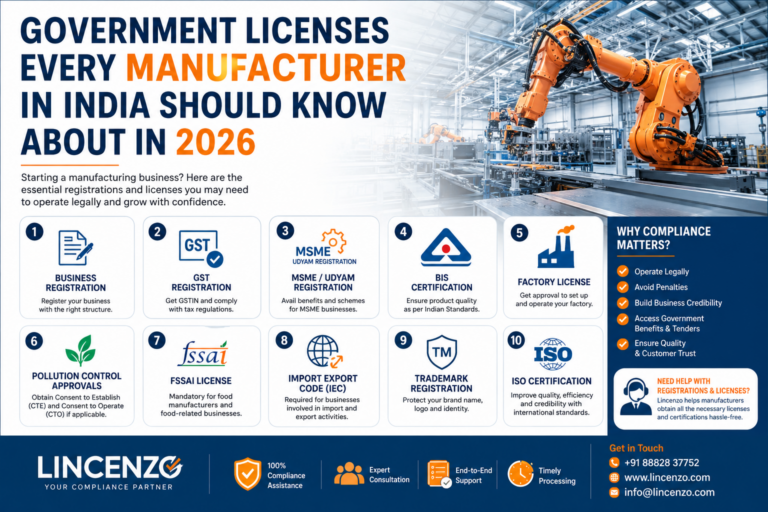
The first step for most entrepreneurs is choosing an appropriate legal structure for the manufacturing business.
Common options include:
The right structure depends on factors such as ownership, investment, liability, taxation and future expansion plans.
A properly established business can also make it easier to open a business bank account, enter into contracts, work with suppliers and customers, and apply for other registrations.
Goods and services sold by manufacturers may be subject to GST requirements depending on applicable laws and thresholds.
GST registration provides the business with a GSTIN and enables it to comply with applicable tax and invoicing requirements.
Manufacturers should understand their GST obligations before starting commercial sales. Depending on the nature and scale of operations, they may also need to maintain appropriate invoices, records and periodic returns.
Because GST requirements can vary according to business circumstances, manufacturers should verify the rules applicable to their particular activities.
Manufacturing businesses that qualify as micro, small or medium enterprises can consider Udyam Registration.
Udyam Registration provides formal recognition under the MSME framework and can help eligible businesses access certain government schemes and benefits.
It may also be useful when establishing the business’s MSME identity while dealing with banks, institutions and other organisations.
Manufacturers should provide accurate business information while completing the registration and keep their records updated when required.
One of the most important compliance areas for certain manufacturers is BIS certification.
The Bureau of Indian Standards develops and maintains Indian Standards and operates conformity-assessment schemes for products.
BIS requirements are product-specific. Some products may have voluntary certification routes, while certification is compulsory for products covered by applicable government notifications, including Quality Control Orders.
Depending on the applicable scheme, the process may involve:
Manufacturers should first check whether their specific product is covered by a mandatory requirement before starting the application process.
Manufacturing activities may also be subject to factory-related licensing requirements under applicable laws and state rules.
The exact requirements can depend on factors such as:
A factory-related approval can involve documentation concerning the premises, manufacturing activity, safety arrangements and other prescribed requirements.
Manufacturers should determine the applicable requirements for their specific location and operation before commencing production.
Environmental compliance is another important area for manufacturing businesses.
Depending on the industry and pollution category, a manufacturer may need approvals from the relevant State Pollution Control Board or other competent authority.
Two commonly discussed approvals are:
Consent to Establish (CTE): Generally relevant before establishing certain industrial operations.
Consent to Operate (CTO): Generally relevant before operating certain industrial activities after the required establishment conditions are fulfilled.
The exact requirements depend on the nature of the industry, scale of operations, environmental impact and applicable state regulations.
Manufacturers should therefore assess environmental requirements during the planning stage rather than waiting until production begins.
Businesses manufacturing, processing, packaging, storing or distributing food products may need an appropriate FSSAI registration or licence.
Food businesses can have different requirements depending on their business activity, production capacity and other applicable criteria.
For example, food manufacturers may need to maintain appropriate documentation and follow requirements concerning food safety, hygiene, labelling and manufacturing practices.
Before starting a food manufacturing operation, entrepreneurs should identify the correct FSSAI category applicable to their business.
Manufacturers involved in international trade may require an Importer Exporter Code (IEC) issued through the Directorate General of Foreign Trade, subject to applicable rules and exemptions.
IEC can be important for businesses importing raw materials, machinery or components and exporting finished products.
For example, a manufacturer producing electronic equipment may import certain components and export finished goods. Understanding import-export requirements before beginning international trade can help prevent avoidable delays.
Businesses should also review whether any additional product-specific export or import requirements apply.
Manufacturers invest significant time and money in developing their brands. Protecting the brand name and logo can therefore be an important part of business planning.
Trademark registration can help provide legal protection for eligible marks and reduce the risk of another business using a confusingly similar brand identifier.
Manufacturers may consider protecting:
Before filing an application, businesses should conduct an appropriate trademark search and identify the relevant class or classes.
Although ISO certification is not automatically mandatory for every manufacturer, it can be valuable for businesses seeking to establish structured management systems.
Depending on business objectives, manufacturers may consider standards such as:
ISO 9001: Quality Management System
ISO 14001: Environmental Management System
ISO 45001: Occupational Health and Safety Management System
ISO 27001: Information Security Management System
The appropriate standard depends on the organisation’s activities and objectives. Certification should also be obtained through an appropriate certification process rather than treating ISO as simply a registration.
Some manufacturing sectors have additional compliance requirements.
Depending on the product, manufacturers may need approvals or registrations related to areas such as:
For this reason, businesses should not rely on a generic licence checklist. A manufacturer producing medical devices can have very different requirements from a manufacturer producing furniture or food products.
Manufacturers often face compliance problems because they begin operations without properly checking applicable requirements.
Some common mistakes include:
Before investing in machinery and production facilities, businesses should identify the licences and approvals that may apply.
For regulated products, selecting the correct Indian Standard is critical. The applicable standard should be verified according to the actual product and government requirements.
Manufacturers should assess pollution-control requirements during the planning and setup stage.
Inaccurate business information, product specifications or technical documents can result in delays or queries.
A business registration does not automatically satisfy product-specific, environmental, tax or industry-specific requirements.
Understanding which registrations apply to a manufacturing business can sometimes be complicated because requirements vary by industry and product.
Lincenzo provides professional assistance for various business registrations, certifications and compliance requirements, including:
Professional assistance can help businesses understand the applicable process, prepare documentation and manage the application requirements more efficiently.
Manufacturing in India offers significant opportunities, but businesses need to pay attention to regulatory and compliance requirements from the beginning.
Depending on the product and business activity, manufacturers may need business registration, GST, MSME registration, BIS certification, factory-related approvals, pollution-control permissions, FSSAI, IEC, trademark protection, ISO certification and other industry-specific approvals.
There is no universal licence package that applies to every manufacturer. The correct requirements depend on the product, manufacturing process, location, scale of operations and applicable regulations.
Therefore, before starting production or expanding an existing manufacturing unit, businesses should identify the registrations and approvals relevant to their specific operations.
Looking for assistance with manufacturing registrations and certifications? Lincenzo can help you understand the applicable requirements and support you through the registration and certification process.
Lincenzo is a trusted business compliance and legal services platform, helping startups, MSMEs, and enterprises simplify registrations, certifications, licenses, and regulatory compliance with expert guidance and end-to-end support.