BIS Registration: Complete Guide
If you manufacture, import, distribute, or sell products in India, understanding applicable quality and conformity requirements is essential. BIS Registration is an important compliance requirement for certain products and businesses. The Bureau of Indian Standards (BIS) is India’s national standards body and administers different product certification and conformity-assessment schemes.
Certification & Licensing
Trademark
Startup
Income Tax
Compliance
Certification & Licensing
Trademark
Startup
Income Tax
Compliance
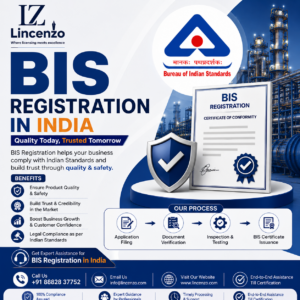
BIS Registration is commonly used to describe the process of obtaining the relevant BIS approval for a product. However, the exact route depends on the product, applicable Indian Standard, and whether the Central Government has made compliance compulsory through a Quality Control Order (QCO).
BIS states that its certification scheme is generally voluntary, but compliance becomes compulsory for products covered by government-notified QCOs. For such products, the applicable Standard Mark must be used under the relevant BIS licence or Certificate of Conformity.
Therefore, businesses should first check their product category instead of assuming that every product follows the same certification process.
BIS Registration can help businesses demonstrate that their products comply with applicable Indian Standards. Depending on the product and scheme, certification can support quality assurance, regulatory compliance, market access, and customer confidence.
For products covered by compulsory certification, obtaining the required approval is more than a marketing advantage. Businesses must comply with the relevant QCO and applicable BIS requirements before manufacturing, importing, selling, or distributing covered products.
A valid BIS approval can also strengthen the credibility of a manufacturer by demonstrating that the applicable conformity requirements have been addressed.
The requirement depends on the product and the applicable Indian Standard or QCO. Manufacturers should first identify the Indian Standard applicable to their product and then determine which conformity-assessment scheme applies.
BIS currently operates different product certification routes, including Scheme-I (Mark Scheme), Scheme-II (Registration Scheme), Scheme-IV (Certificate of Conformity), and Scheme-X certification. The appropriate route depends on the product and applicable notification.
Foreign manufacturers may also need BIS approval for products intended for the Indian market. BIS operates the Foreign Manufacturers Certification Scheme (FMCS), under which a licence can be granted to foreign manufacturers whose products conform to relevant Indian Standards.
The exact BIS Registration process can vary according to the product and certification scheme, but the following stages provide a useful overview.
The first step is to identify the Indian Standard (IS) applicable to your product. BIS advises manufacturers to search for the relevant standard before applying.
This is critical because the applicable standard determines technical requirements, testing requirements, manufacturing controls, and other conditions.
After identifying the standard, the manufacturer should assess its production infrastructure, process controls, quality-control arrangements, testing capabilities, and other requirements.
BIS specifically states that manufacturers need appropriate manufacturing infrastructure, process controls, quality-control and testing capabilities corresponding to the applicable Indian Standard.
The documentation required for BIS Registration depends on the product and certification scheme. Common information may include:
Additional declarations, test reports, authorization documents, or technical records may be required depending on the product.
BIS states that applications for product certification are accepted through online mode, including online payments. Applications are submitted through the relevant BIS online portal.
Applicants should ensure that all information and supporting documents are accurate before submitting the application.
An important part of the BIS Registration process can involve assessment of the manufacturing premises, infrastructure, process controls, quality-control arrangements, and testing capabilities.
Depending on the applicable scheme, product conformity may be established through third-party laboratory testing, testing at the manufacturing premises, or a combination of testing approaches.
If the application, inspection, testing, and other applicable requirements are successfully completed, BIS can grant the relevant licence, registration, or certificate according to the applicable scheme.
Businesses must use the relevant Standard Mark only according to the conditions of the approval. BIS also requires the applicable licence number to be indicated with the Standard Mark in relevant circumstances.
The exact document checklist for BIS Registration varies by product and scheme. Applicants should generally be prepared with:
BIS provides product-specific manuals and guidelines that can include testing requirements, sampling information, inspection and testing schemes, and scope details.
Using a generic document checklist without checking the relevant product manual can result in missing documents or unnecessary delays.
There is no single fee applicable to every product. The cost of BIS Registration can depend on the certification scheme, product category, testing requirements, inspection requirements, applicant category, and applicable marking fees.
For example, BIS’s FAQ states that under Scheme-I product certification, an application fee of ₹1,000 and an inspection fee of ₹7,000 per man-day apply under the stated conditions. After the licence decision, the applicable annual licence fee and minimum marking fee are payable.
These figures should not be treated as a universal price for every BIS application because different schemes and products can have different fee structures.
The timeline for BIS Registration depends on the product, certification scheme, application completeness, testing requirements, inspection scheduling, and responses to queries.
BIS states that the average time for grant of a product certification licence under Option-2 is generally around one month, while Option-1 is generally around four months from receipt and recording of a complete application. BIS also notes that the actual timeline may vary due to queries, inspection arrangements, sample deposition, and fee-related matters.
Therefore, businesses should be cautious about providers promising a fixed approval date without reviewing the product and applicable requirements.
When applying for BIS Registration, businesses should avoid the following mistakes:
A proper pre-application assessment can help identify these issues before the application is submitted.
At Lincenzo, we provide professional assistance to businesses seeking support with BIS-related certification and compliance requirements.
Our assistance can include:
Because every product has different requirements, we first help businesses understand the applicable standard, product category, manufacturing location, and certification route.
The BIS Registration process can involve technical documentation, product testing, inspections, online applications, and regulatory coordination. Professional assistance can make it easier for businesses to understand the requirements and organize the application correctly.
Lincenzo focuses on practical guidance, documentation support, transparent communication, and end-to-end assistance for business registrations, certifications, and licensing requirements.
BIS Registration can be an important compliance requirement for manufacturers and businesses dealing with products covered by applicable Indian Standards and government regulations. The right approach starts with identifying the applicable standard and certification scheme, followed by documentation, testing, inspection, application processing, and compliance with the conditions of approval.
If you are unsure whether your product requires BIS approval or which certification route applies to your business, getting professional guidance before applying can help you avoid unnecessary errors and delays.
Lincenzo is a trusted business compliance and legal services platform, helping startups, MSMEs, and enterprises simplify registrations, certifications, licenses, and regulatory compliance with expert guidance and end-to-end support.