
What Happens After Business Registration? 9 Compliance Steps Entrepreneurs Often Miss
Registering a business is an important milestone, but it is not the final step in becoming operationally ready. Many entrepreneurs assume that once their company, LLP or business entity has been registered, they can immediately start operating without worrying about additional requirements. In reality, business registration is often only the starting point of the compliance journey. Depending on the nature of the business, entrepreneurs may need to consider tax registrations, sector-specific licences, employee-related requirements, product approvals, local permissions, accounting systems and ongoing statutory filings. This is why understanding post business registration compliance is important for startups as well as established businesses. Here are nine areas every entrepreneur should review after registering a business.
Certification & Licensing
Trademark
Startup
Income Tax
Compliance
Certification & Licensing
Trademark
Startup
Income Tax
Compliance
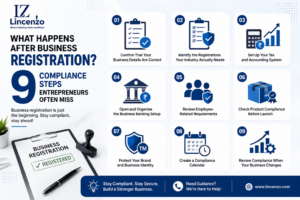
The first step after registration should be reviewing the information submitted during incorporation or registration.
Check details such as:
Even a small error in official records can create complications later when opening bank accounts, applying for licences or submitting other applications.
Keeping your basic business information consistent across documents can make future compliance much easier.
Not every business needs the same licences.
A consulting company may have a very different compliance profile from a food manufacturer, electronics seller, importer or factory.
After registration, entrepreneurs should therefore ask:
What does my business actually do?
Then identify the approvals connected to those activities.
For example, depending on the business, requirements may relate to:
The objective should not be to collect unnecessary registrations. Instead, businesses should identify the requirements that genuinely apply to their activities.
A registered business also needs an organised financial system.
Entrepreneurs should establish a proper process for:
Businesses that delay accounting often find themselves struggling when tax filings or financial reporting deadlines arrive.
A simple accounting system from the beginning can save considerable time later.
Keeping business and personal finances separate is an important operational practice.
A dedicated business bank account can make it easier to track:
Entrepreneurs should also maintain proper records of business transactions rather than relying entirely on personal accounts.
Good financial organisation becomes increasingly important as the business grows.
If your business has employees, compliance doesn’t stop at hiring people.
Depending on the size, location and nature of the organisation, different employment-related requirements may apply.
Businesses should establish systems for:
A growing business should review these requirements periodically because its obligations may change as the workforce expands.
Product-based businesses need an additional layer of planning.
Before manufacturing, importing or selling a product, businesses should determine whether the product falls under any mandatory certification, testing, labelling or quality-control requirement.
This is particularly important for businesses operating in regulated product categories.
A useful approach is to create a product compliance checklist containing:
Product → Applicable Standard → Testing → Certification → Labelling → Market Launch
Checking these requirements before launch can help avoid expensive changes later.
Business registration and brand protection are not necessarily the same thing.
Entrepreneurs often spend significant time creating a company name, logo and brand identity but don’t consider how those assets are protected.
Depending on the business, it may be useful to evaluate intellectual-property protection such as:
A strong brand is an asset, and protecting it early can become increasingly valuable as the business gains customers.
One of the simplest ways to manage post business registration compliance is to create a compliance calendar.
Instead of keeping deadlines in different emails, documents or messages, maintain one central list.
For example:
| Compliance Area | Status | Review Date |
|---|---|---|
| Tax registrations | Active | Periodic review |
| Corporate filings | Active | As applicable |
| Industry licence | Pending/Active | Renewal/review |
| Employee compliance | Active | Periodic review |
| Product certification | Applicable/Not applicable | As required |
| Local permissions | Active/Pending | As applicable |
The exact deadlines depend on the business structure and applicable laws, so businesses should verify them with the relevant authority or professional advisor.
This is one of the most overlooked areas.
Your compliance requirements can change when your business changes.
For example, you might:
A registration that was sufficient for a small service business may not cover everything required after the company becomes a manufacturer or importer.
That’s why compliance should be reviewed whenever there is a major change in business activity.
Before starting full-scale operations, ask yourself:
✓ Is my business information accurate?
✓ Have I identified the licences applicable to my industry?
✓ Is my accounting system ready?
✓ Are my tax requirements properly reviewed?
✓ Is my business banking organised?
✓ Have I reviewed employee-related requirements?
✓ Is my product compliant before launch?
✓ Have I considered brand protection?
✓ Do I have a compliance calendar?
✓ Will I review compliance when my business expands?
If the answer to several of these questions is “no”, your business may need a more detailed compliance review before scaling operations.
Business registration gives an entrepreneur a legal foundation, but building a compliant business requires more than obtaining a certificate.
The next stage is understanding what your specific business needs to operate responsibly and efficiently.
Instead of waiting for a notice, rejection or compliance problem, businesses can adopt a proactive approach by reviewing their registrations, licences, documentation and operational requirements regularly.
At Lincenzo, we assist businesses with a range of registrations, certifications and compliance-related requirements. Our objective is to help businesses understand the applicable process and documentation so they can move forward with greater clarity.
Your registration is the beginning—not the end—of your business compliance journey.

Lincenzo is a trusted business compliance and legal services platform, helping startups, MSMEs, and enterprises simplify registrations, certifications, licenses, and regulatory compliance with expert guidance and end-to-end support.