
Certification & Licensing
Trademark
Startup
Income Tax
Compliance
Certification & Licensing
Trademark
Startup
Income Tax
Compliance
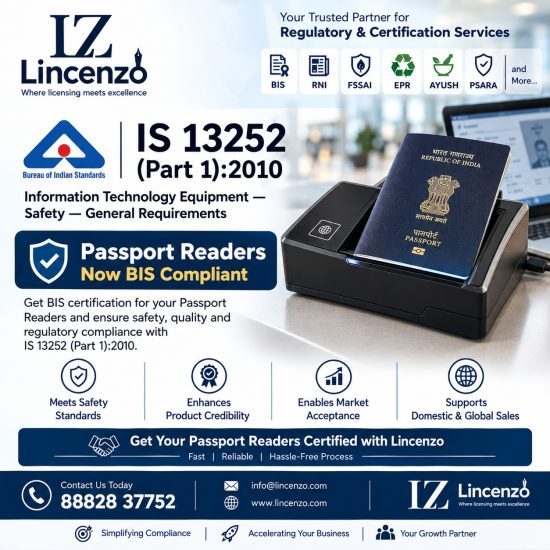
Passport readers are machines used to scan the MRZ (machine readable zone) of passports. In addition, they are used to read the RFID chip embedded in e-passports. They are commonly found in airports, visa offices, immigration counters, hotels, and banks. Since they are mains-powered or USB-powered machines which are handled throughout the day, they should be safe.
IS 13252 (Part 1) pertains to ITE having a rated voltage that should not exceed 600 V. The intention of this standard is to ensure safety against hazards, which include the following:
For the passport reader device, this translates to the evaluation of the power source, internal wiring, circuit boards, casing, labels, and lighting and scanning mechanisms. The USB cord and other attachments like the adapter are also pertinent in case they are part of the product.
Legal requirement. According to the order, these devices can neither be produced, nor imported, sold or stocked in India without obtaining BIS registration and the Standard Mark.
User protection. The operator comes into contact with the device on a regular basis. This standard guarantees protection from electric shock, fire, burns, and injuries from moving parts.
Market accessibility. A product cannot be imported, tendered and sold without registration.
Trust and liability. There is a tendency among government agencies and security-conscious clients to use only certified products. The registered product proves that it was independently tested according to recognized safety requirements, which will also reduce manufacturer’s responsibility for incidents caused by the product.
Consistency. One standard ensures the same requirements for each manufacturer.
Step 1: Identify the Scope. Ensure that your passport reader is covered under the CRS list and identify the standard version specified by BIS for your reader.
Step 2: Get Documentation Ready. Get the circuit diagram, bill of materials, critical components list, photos of the product, manual and labels prepared. Datasheets of all components and certificates should be readily available.
Step 3: Appoint Authorised Indian Representative (AIR). Foreign companies should appoint an AIR who will be responsible for the registration process in India.
Step 4: Get Tested at a Recognized BIS Laboratory. Insulation Strength, Temperature Rise, Abnormal Conditions, Markings and other tests are conducted on the samples. Testing can take a few weeks and failures would mean designing the product again and then testing.
Step 5: Factory Inspection. BIS or its nominated agency might want to inspect the factory to ensure consistency in manufacturing.
Step 6: Online Application on the BIS Portal. Upload your test report and other necessary documents.
Q1. Is IS 13252 (Part 1):2010 an international standard?
Technically, it is an equivalent of IEC 60950-1 but with national differences specific to India.
Q2. Do all passport readers fall under its purview?
Only those included in the list of the notified CRS products. The latest BIS notification should be checked for the precise description of products.
Q3. Who needs to get registered – the manufacturer or the importer?
The former, for domestic companies, and the latter, for foreign producers who have to designate their Authorised Indian Representative.
Q4. Am I allowed to sell a passport reader without a BIS mark?
No. Import, sale and distribution of a notified product without being registered are offences.
Q5. How long does the certification process usually take?
It depends on many factors including the laboratory schedule, quality of documentation and results of tests. It may take several months.
Q6. What happens if I make changes in the registered model?
Changes of important components and/or design may require reporting.
IS 13252 (Part 1):2010 sets a clear guideline for manufacturers and importers of passport readers to manufacture safe passport readers with proper sound insulation, temperature control, fire resistance, marking and safe behavior in case of malfunction. Complying with the standard would ensure safety of the users, adherence to laws of India and increase trust of the buyers in the market.
If you want to design or import passport readers, you should take the right steps right from the start. You should start early, use an accredited lab, have your documents in order and verify the latest standard version from BIS.

Lincenzo is a trusted business compliance and legal services platform, helping startups, MSMEs, and enterprises simplify registrations, certifications, licenses, and regulatory compliance with expert guidance and end-to-end support.