Certification & Licensing
Trademark
Startup
Income Tax
Compliance
Certification & Licensing
Trademark
Startup
Income Tax
Compliance
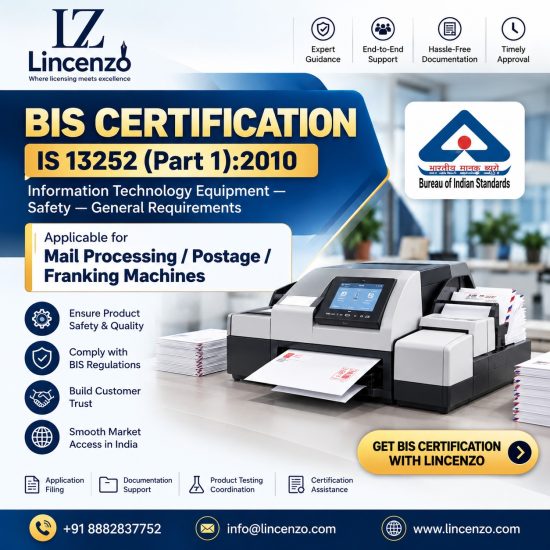
Postage metering and franking machines are commonly used in offices, courier centers, and postal services for processing mail efficiently. These machines handle large volumes of mail, operate on a grid power supply, and contain movable components that may pose electrical and mechanical safety risks. BIS Certification for Mail Processing Machines helps ensure that applicable products meet the required safety standards. Businesses should verify the relevant product category and applicable IS 13252 Part 1:2010 Standard before applying for BIS CRS Registration. For more information about the process and requirements, visit BIS Certification and understand the applicable compliance requirements for your product.
IS 13252 (Part 1):2010 is the name of the Indian Standard for “Information Technology Equipment: Safety, Part 1: General Requirements.” The technical alignment of this standard is in accordance with the international standard IEC 60950-1. The scope of the standard includes the safety of information technology equipment, electrical business equipment, and related devices up to a rated voltage of 600 volts.
The mail processing, postage and franking machines have been included under the BIS Compulsory Registration Scheme, which falls under the provisions of the Electronics and IT Goods (Requirements for Compulsory Registration) Order.
1. Safety for Users. Office equipment is used by many people on a daily basis. This standard reduces the risk of electrical shock, fire, burns, and mechanical injuries.
2. Legal Requirements. Sale and import of notified products without BIS registration is not allowed. Non-compliance may result in legal sanctions, seizure of the goods and delays in customs clearance.
3. Credibility. The BIS Standard Mark informs the consumer, government organizations and companies’ purchasing department about independent testing of the product.
4. Product Quality and Reliability. Usually design according to internationally recognized standard positively impacts product quality and reliability and decreases warranty claims.
5. Fair Competition. The certification scheme maintains a level playing field for compliant manufacturers preventing non-conformant imports.
Global safety standards for IT and audio video equipment have changed from the older standard of IEC 60950-1 to the more recent IEC 62368-1 with a hazard-based approach to safety assessment. In India, this alignment has happened using the IS 62368-1 standard. It is advisable for manufacturers to refer to BIS and MeitY notifications to ascertain the applicable standard for their product group.
– Incorporate safety considerations while designing the product so as to prevent any possible dangers in mail processing machinery.
– Choose quality electrical components that are capable of meeting the safety standards required by the specific application.
– Keep technical data related to the product specification, circuit diagrams, and manufacturing.
– Collaborate with an authorized laboratory in determining the product safety specifications and the required test process.
– Ensure the quality and safety of the product are checked at all times when there is change in manufacturing process, material, and design of the product.
– Be aware of the Electronic Equipment Safety Certification requirements before introducing any product in India.
– Confirm the BIS Registration for Mail Processing Machines requirements.
The route to BIS registration generally follows these steps:
Step 1: Determine the scope of the product. Make sure that your product comes under the notified category and its corresponding standards.
Step 2: Appoint an Authorised Indian Representative (AIR). It is mandatory for foreign manufacturers to appoint an AIR in India for their application process and communication with BIS.
Step 3: Testing. Send the samples of your product to a laboratory recognised by BIS and get tested for conformity with IS 13252 (Part 1):2010.
Step 4: Apply. Apply to BIS through their online portal using your test report, technical documents, circuit diagram, critical components, declarations and fees.
Step 5: Factory inspection (if required). In case BIS feels the need, they can conduct factory inspection particularly for overseas manufacturing facilities to check the manufacturing and quality control practices.
Step 6: Grant registration. Upon examination, BIS will issue you a registration which will have a unique R-number assigned to it.
Step 7: Marking. Your product shall bear the Standard Mark along with the R-number.
Q1. What is IS 13252 (Part 1):2010?
It is the Indian safety standard for information technology equipment, equivalent to IEC 60950-1.
Q2. To what kind of machines is it applicable?
Mail processing, postage and franking machines.
Q3. Is BIS registration compulsory?
Yes, for notified products.
Q4. What is tested for?
Shock hazard, fire hazard, moving parts, heat, wiring, stability and marking.
Q5. Who is subject to the regulations?
Indian manufacturers and importers. Manufacturers from other countries require an Authorized Indian Representative (AIR).
Q6. What is the procedure for registration?
Conduct testing at a BIS-approved lab, submit application on the BIS portal, conduct factory inspection if required, obtain your R-number.
Q7. What happens if you don’t register?
Penalties, confiscation of the goods and customs problems.
IS 13252 (Part 1):2010 ensures that the end users of mail processing, postage and franking machines are safe. Additionally, IS 13252 (Part 1):2010 is the key to entry into the Indian market for manufacturers and importers. Being aware of what the standard is about, why it is important and the process of BIS Registration will help you ensure compliance without any hindrances. With the industry making moves towards IS 62368-1, being updated with the regulations is the only way.
Lincenzo is a trusted business compliance and legal services platform, helping startups, MSMEs, and enterprises simplify registrations, certifications, licenses, and regulatory compliance with expert guidance and end-to-end support.