
FSSAI License Process for Food Businesses — Complete Guide (2026)
Starting a food business in India requires proper legal compliance to ensure food safety and quality standards. One of the most important registrations for any food-related business is the FSSAI License, issued by the Food Safety and Standards Authority of India (FSSAI). Whether you run a restaurant, cloud kitchen, food manufacturing unit, or online food business, obtaining an FSSAI license is mandatory under the Food Safety and Standards Act, 2006. In this guide, we will explain the complete FSSAI license process, types of licenses, required documents, costs, and step-by-step application procedure.

Rated at 4.9 By 43034 + Customers Globally
Certification & Licensing
Trademark
Startup
Income Tax
Compliance
Certification & Licensing
Trademark
Startup
Income Tax
Compliance
Certification & Licensing
Trademark
Startup
Income Tax
Compliance
Certification & Licensing
Trademark
Startup
Income Tax
Compliance
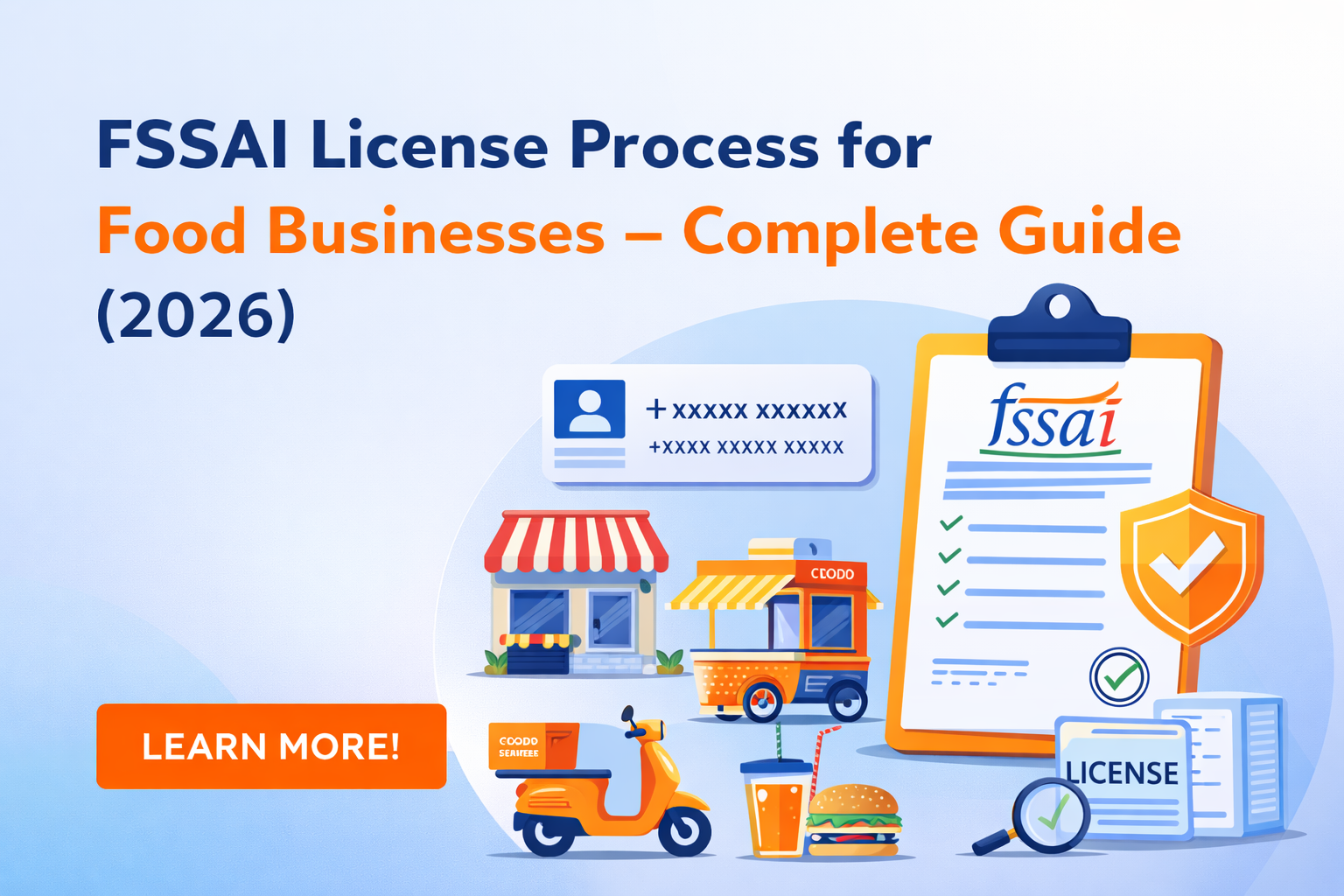
The FSSAI license is a certification issued by the Government of India that ensures food businesses comply with safety, hygiene, and quality standards. After approval, businesses receive a 14-digit FSSAI registration or license number, which must be printed on food packaging and displayed at business premises.
Having an FSSAI license increases customer trust and protects businesses from legal penalties.
Any individual or company involved in food-related activities must obtain an FSSAI license. This includes:
Restaurants and cafes
Food manufacturers and processors
Cloud kitchens and home kitchens
Food delivery businesses
Food importers and exporters
Retail shops and supermarkets
Wholesalers and distributors
Dairy and meat processing units
Online food sellers (Amazon, Flipkart, Swiggy, Zomato)
Even small home-based food businesses require at least FSSAI registration
FSSAI License Process for Food Businesses:
There are three main categories based on business size and annual turnover:
For small businesses and startups
Annual turnover up to ₹12 lakh
Suitable for home kitchens, small vendors, and petty food businesses
For medium-sized businesses
Annual turnover between ₹12 lakh to ₹20 crore
Required for restaurants, manufacturers, storage units, distributors
For large businesses and import/export units
Turnover above ₹20 crore
Mandatory for companies operating in multiple states or dealing in imports/exports
Choosing the correct license type is very important to avoid rejection or penalties.
The required documents vary depending on license type, but generally include:
PAN card of applicant or business
Aadhaar card / ID proof
Passport-size photograph
Business address proof (rent agreement or electricity bill)
NOC from property owner
Food safety management plan
List of food products
Equipment details (for manufacturers)
Partnership deed / Incorporation certificate (for companies)
Import Export Code (for import/export businesses)
Proper documentation helps in faster approval
FSSAI License Process for Food Businesses.
First, identify whether you need Basic, State, or Central FSSAI license based on turnover and business nature.
Collect all required documents as per your business category.
Apply through the official FSSAI portal (FoSCoS) by filling Form A (Basic) or Form B (State/Central).
The department verifies documents and may request additional information if required.
For manufacturing or large businesses, authorities may conduct a site inspection.
After successful verification, the FSSAI license is issued with a unique 14-digit number.
Fees depend on license type and duration:
Basic Registration: ₹100 per year
State License: ₹2,000 – ₹5,000 per year
Central License: ₹7,500 per year
Professional consultancy charges may apply if you hire experts for processing FSSAI License Process for Food Businesses:
FSSAI licenses are valid from 1 to 5 years, depending on the selected duration during application.
Renewal must be done 30 days before expiry to avoid penalties. Late renewal may lead to license cancellation.
Obtaining an FSSAI license provides multiple advantages:
Legal compliance with government regulations
Builds customer trust and brand credibility
Helps expand business across India
Required for selling on online platforms
Ensures food safety and hygiene standards
Avoids heavy penalties and legal issues
Improves business reputation
For food businesses, FSSAI certification is not just mandatory but also beneficial for long-term growth.
Running a food business without an FSSAI license can lead to serious consequences:
Fine up to ₹5 lakh
Business closure
Legal action by authorities
Therefore, obtaining the license before starting operations is essential.
Many business owners face difficulties in selecting the correct license type, preparing documents, and dealing with government procedures. Professional consultants can simplify the process by:
Identifying the right license category
Preparing documentation
Filing application correctly
Handling department queries
Ensuring faster approval
This saves time and avoids rejection risks.
The FSSAI license is a mandatory requirement for any food business operating in India. Whether you are starting a small home kitchen or a large food manufacturing company, obtaining the correct FSSAI registration ensures legal compliance, food safety, and customer confidence.
By following the proper application process and submitting accurate documents, businesses can obtain approval smoothly and focus on growth.
If you are planning to start a food business, applying for an FSSAI license should be your first step toward success.
We are India’s trusted business service provider, helping entrepreneurs and companies with registrations, licenses, compliance, and certifications. From startup to scale-up, we ensure hassle-free, fast, and reliable solutions for all your business needs.
Serving Partners

Quick Links
Services
Payment Methods
Get In Touch
Lincenzo Private Limited
Mon - Sat: 10:00 AM - 06:45 PM
Sunday : Closed
Need Help? Contact Us

Lincenzo Private Limited All Right Reserved | Privacy Policy
Rated at 4.9 By 43034 + Customers Globally