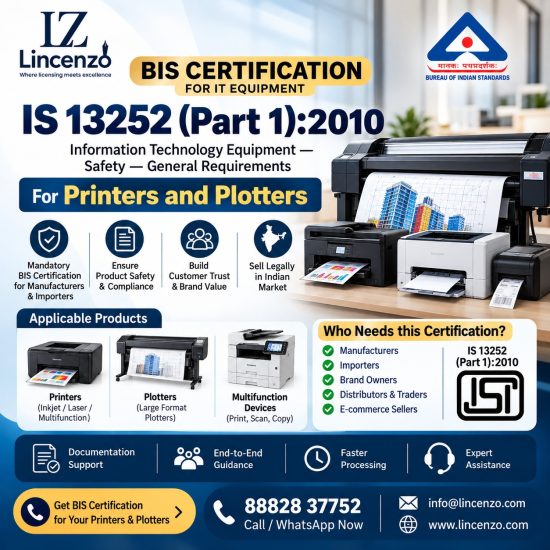
Printers and plotters are common in offices, schools, businesses, design studios, engineering firms and industrial environments. Products include electrical circuits, power supplies, motors, control systems and other electronic components. Safety requirements are therefore important to minimize possible risks during normal use.
The standard addresses general safety issues for covered information technology equipment. Depending on the product’s design and construction, relevant safety considerations might include protection against electric shock, insulation, electrical connections, temperature, mechanical hazards, and other potential risks.
Identification of the correct Indian Standard is an important aspect of product compliance for manufacturers and importers. Where BIS requirements apply, products may need to be tested to the relevant requirements and be supported by appropriate technical documentation before being placed on the Indian market.
Product: Printers and Plotters
Category: Information Technology Equipment
Standard: Safety – Part 1: General Requirements
Objectives: Ensure the appropriate safety requirements for IT equipment are addressed
Safety Aspects: Electrical safety, insulation, construction, temperature, and mechanical protection
Testing: Relevant products could be subjected to testing against the appropriate requirements
Documents: Appropriate technical specifications, test reports, manufacturers’ information, and other relevant documents could be required
Compliance: Manufacturers/importers need to check for the current appropriate BIS requirements for the relevant products before marketing them in India
Importance of Safety Compliance
Printers and plotters can run for extended periods and may have moving and heat generating parts. The proper safety assessment will help to determine any possible hazards.
Observance of applicable guidelines will also be helpful for demonstrating conformance to Indian regulatory requirements. Conformity with the guidelines may boost the confidence of customers and business associates.
General BIS Compliance Process
The initial step in this process is identification of the product type and Indian Standard applicable to that product. Once that is completed, testing of the product based on the safety standards can be done at any relevant laboratory.
Once the required test report has been obtained, it becomes easy for the manufacturer to prepare all the documents related to the product specifications, technical documentation, manufacturer information, among others.
Notes
Note 1: The relevance of IS 13252 (Part 1):2010 depends on the particular model of the printer/plotter being used and its technicalspecifications/designs and uses.
Note 2: BIS requirements may be changed or moved on to new standards. Therefore, manufacturers/importers need to check their relevant BIS requirements before embarking on the present certification process.
Note 3: Tests/documentation/registration requirements may differ according to the particular product and relevant BIS scheme.
Conclusion
IS 13252 (Part 1):2010 offers the general safety requirements relating to the covered IT equipment that include printers and plotters. Knowledge of the applicable standard, conducting tests as needed, and ensuring that technical documents are up to date will be of help to manufacturers and importers in meeting their responsibilities.