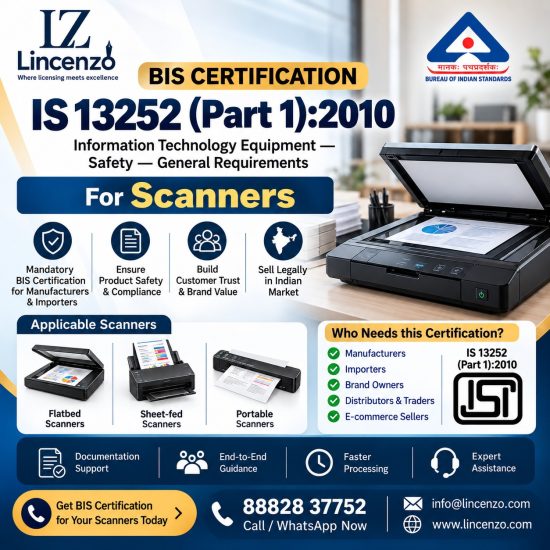
Scanners are used to convert physical documents, photographs and other materials into digital formats in offices, schools, businesses, government agencies, libraries and commercial establishments. These devices contain electrical circuits, power supplies, motors, sensors and other electronics. Therefore, suitable safety requirements are important for reliable and safe operation.
The standard addresses general safety concerns that are common to covered IT equipment. Safety aspects relevant to the design and construction of the scanner may include protection against electric shock, insulation, electrical connections, temperature, mechanical and other hazards.
Manufacturers and importers consider it an important aspect of product compliance to identify the Indian Standard that applies. Where applicable, scanners may be subject to appropriate testing and required documentation and registration conditions prior to being placed on the Indian market, in accordance with BIS requirements.
- IS Code: IS 13252 (Part 1):2010
- Product: Scanner
- Category: Computer Networking Equipments
- Standard: Safety – Part 1: General Requirements
- Purpose: To meet applicable safety requirements for IT equipment
- Safety Areas: Electrical safety, insulation, construction, temperature, mechanical protection
- Testing: Applicable products may need to be tested according to relevant requirements
- Documentation: Technical specifications, test reports, manufacturer details and other applicable documents may be required
- Compliance: Manufacturers and importers should ensure that they are aware of the latest applicable BIS requirements before selling covered products in India.
Importance of Safety Compliance
Scanners are electrical devices used in the workplace and commercial environments on an ongoing basis. They can also include moving parts and power components. Proper safety evaluation allows manufacturers to identify hazards and improve product design.
Meeting applicable requirements can help companies show compliance with relevant Indian regulatory requirements and give greater confidence to customers, distributors and business partners.
General BIS Compliance Process
The general process of compliance starts with identification of the correct product category and the applicable Indian Standard. The relevant laboratory may then carry out assessment and testing of the product according to the relevant requirements.
Then the manufacturer can prepare technical specifications, product information, company documents and other supporting records after acquiring the required test report. The relevant BIS application can be filed for review under the appropriate conformity assessment scheme.
Notes
Note 1: Compliance with IS 13252 (Part 1):2010 is dependent on the particular scanner model, specifications, design, construction and intended use.
Note 2: BIS standards and product requirements may be updated or moved to new standards. Manufacturers and Importers should verify the current applicable BIS requirements before starting a current certification application.
Note 3: The testing and documentation requirements may vary based on the product and applicable BIS scheme.
Conclusion
IS 13252 (Part 1):2010 specifies general safety requirements for the subject matter of applicable information technology equipment including scanners within its scope. Manufacturers and importers can fulfilll their regulatory obligations and ensure scanners operate safely and reliably in the Indian market by adhering to the relevant standard, performing the necessary testing, and keeping the required technical documentation.