Certification & Licensing
Trademark
Startup
Income Tax
Compliance
Certification & Licensing
Trademark
Startup
Income Tax
Compliance
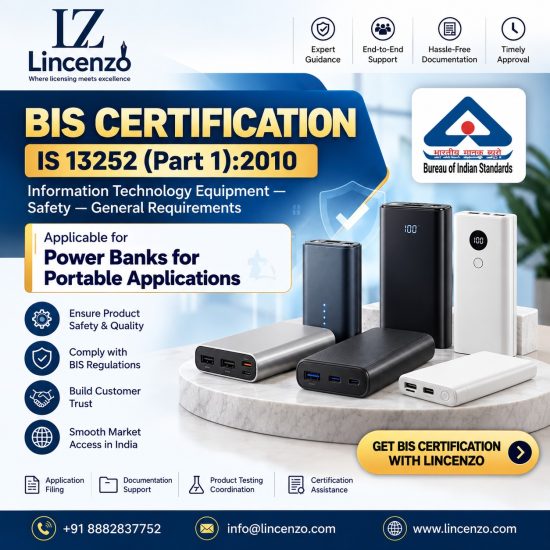
Power banks generally consist of rechargeable battery cells, charge/discharge circuits, connectors and protection components. They must be designed and constructed to minimize hazards such as overheating, short-circuiting, and electrical failure. The specific safety tests required will depend on the classification of the product and the applicable standard or regulatory scheme.
BIS compliance helps manufacturers and importers to understand and comply with the regulatory requirements applicable to their products in India. Where certification or registration is mandatory, businesses must follow the prescribed process prior to marketing the product.
Compliance with applicable requirements can support consumer safety, enhance product reliability and build trust among customers and business partners. It can also help businesses avoid the risk of regulatory delays, product recalls and other compliance-related issues.
Businesses that plan to manufacture or import power banks should follow a structured compliance process:
Power banks have re-chargeable cells and electronic circuits and need the right safety protection. Poor-quality products may overheat, short circuit, overcharge or damage the battery. Good design, proper protective circuits and correct testing help to reduce these risks and make everyday use safer.
Do not assume that IS 13252 (Part 1):2010 is the correct and latest standard for all power banks. The applicable standard and the certification route may vary for different products and according to the current BIS guidelines. It is advisable to check the latest requirements before manufacturing, importing or selling power banks in India.
Q1. What is IS 13252 (Part 1):2010?
It is an Indian Standard. 2. SCOPE This standard deals with general safety requirements for information technology equipment.
Q2. Why is the safety of power banks important?
Power banks contain rechargeable batteries and electronic circuits which must be protected against dangers such as overheating and short circuits.
Q3. Is it mandatory for all power banks to have BIS certification?
The applicable regulation is dependent on the classification of the product and the current Indian regulations. Companies should consult the latest official BIS notifications.
Q4. What documentation may be required for BIS compliance?
Depending on the scheme, documents can include details of the manufacturer, product specifications, test reports and application forms.
Q5. When must a business obtain BIS approval?
If a product is subject to approval, businesses should first check the standard and regulatory requirements applicable and follow the prescribed process before selling the product.
Power banks are useful gadgets but the rechargeable batteries and electronic parts make safety a major concern. Manufacturers and importers should correctly classify the products, check the latest requirements of BIS and conduct any mandatory testing and registration before placing the products in the Indian market. Proper compliance helps build consumer trust and promotes responsible business practices.

Lincenzo is a trusted business compliance and legal services platform, helping startups, MSMEs, and enterprises simplify registrations, certifications, licenses, and regulatory compliance with expert guidance and end-to-end support.