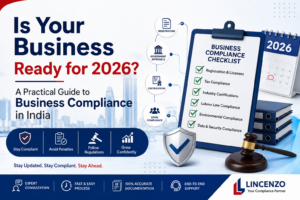
Is Your Business Ready for 2026? A Practical Guide to Business Compliance in India
Running a business in India is no longer only about registering a company and starting operations. As a business grows, it can become subject to different registrations, licences, certifications, tax requirements, labour obligations and industry-specific approvals. In 2026, this becomes even more important because India's regulatory environment is continuing to move toward digital processes, simplified approvals, risk-based inspections and reduced procedural burden. The Government has reported that more than 47,000 compliances have been reduced through simplification, digitisation, decriminalisation and removal of redundant requirements. For business owners, the real question is not simply “Do I have a registration?” The better question is: “Are all the registrations, licences and compliance requirements applicable to my business currently in order?” This guide explains how businesses can approach business compliance in India 2026 in a more organised way.
Certification & Licensing
Trademark
Startup
Income Tax
Compliance
Certification & Licensing
Trademark
Startup
Income Tax
Compliance
One of the biggest mistakes businesses make is looking only at their company registration.
Your compliance requirements are usually influenced by what your business actually does.
For example, a technology company, food manufacturer, importer, electronics manufacturer and security agency can have completely different regulatory requirements even if all of them are private limited companies.
Before checking licences, create a basic profile of your business:
This activity-based approach makes it much easier to identify the registrations that may actually apply.
MSME status can be important for businesses looking for access to Government schemes, finance and other benefits.
The Udyam Registration system provides a paperless, self-declaration-based registration mechanism for MSMEs. The Government’s August 2026 update reported a substantial increase in registrations on the Udyam portal.
In August 2026, Parliament also passed the MSME Development (Amendment) Bill, 2026, introducing amendments intended to support the growth and development of the MSME sector.
Therefore, businesses should avoid treating their MSME registration as something that can simply be forgotten after obtaining it.
Review whether:
There is no universal licence that makes every business compliant.
A company may need additional approvals depending on its industry.
For example:
Food businesses may need FSSAI registration or licensing.
Manufacturers may need product-specific certifications, quality approvals or factory-related permissions.
Importers and exporters may need IEC and other sector-specific approvals.
Security agencies may require PSARA-related compliance.
Businesses handling certain environmental activities may need applicable pollution control approvals.
Electronics and IT product manufacturers may fall under specific mandatory certification or registration frameworks.
This is why a compliance audit should begin with your business activity rather than simply searching for “company registration.”
Food businesses have seen some of the most noticeable regulatory changes in 2026.
From 1 April 2026, the FSSAI registration turnover threshold increased from ₹12 lakh to ₹1.5 crore, while the State licence threshold was increased up to ₹50 crore, with Central licensing applicable above that level. The revised framework also provides for perpetual validity of registrations and licences.
Additional amendments notified in June 2026 also rationalised certain record-keeping and FIFO/FEFO requirements for non-manufacturing food businesses while retaining important controls for food manufacturers.
This demonstrates why businesses should not rely on old blog posts or outdated information when determining their current compliance position.
Companies and LLPs should regularly review their corporate records instead of focusing only on annual filing deadlines.
One notable 2026 change is the revision of director KYC requirements.
The Ministry of Corporate Affairs replaced the annual KYC requirement with an abridged KYC intimation once every three years, effective from 31 March 2026. The revised process can also be used for updating certain director details and reactivation of DIN.
Businesses should therefore check:
A simplified requirement does not mean that corporate records can be ignored.
Manufacturers often face a more complex compliance environment because requirements can depend on the specific product.
Before launching a product, manufacturers should identify whether any mandatory standard, certification, testing or quality-control requirement applies.
India’s mandatory quality-control framework has expanded significantly. Government data reported 143 Quality Control Orders covering 723 products as of 31 December 2025.
For manufacturers, this means product compliance should ideally be checked before commercial production or market launch, rather than after a problem arises.
A basic manufacturer compliance review can include:
Businesses dealing with packaged commodities should also review Legal Metrology requirements where applicable.
In 2026, the Government introduced an Improvement Notice mechanism under the Legal Metrology Act for specified first-time procedural or regulatory non-compliances. The mechanism gives eligible businesses an opportunity to correct the deficiency before penalty proceedings are initiated.
The reform reflects a broader shift toward encouraging businesses to correct procedural mistakes while maintaining consumer protection.
For businesses dealing with packaged goods, it is therefore worth reviewing areas such as:
Government compliance is increasingly moving online.
The National Single Window System (NSWS) helps businesses identify and apply for approvals based on their business requirements. According to the Government’s August 2026 update, the system integrates approvals across 32 Central ministries and 34 States and provides access to hundreds of central and thousands of state approvals.
Similarly, SPICe+ integrates several procedures associated with company incorporation, while MCA21 V3 supports digital corporate services.
Businesses should take advantage of these systems rather than relying entirely on manual processes.
However, digital submission does not remove the responsibility of providing accurate information.
One of the simplest ways to improve business compliance is to maintain a central compliance calendar.
Create a spreadsheet containing:
| Compliance Area | Applicable? | Status | Due Date |
|---|---|---|---|
| GST | Yes/No | Active/Pending | Date |
| MSME/Udyam | Yes/No | Active | — |
| FSSAI | Yes/No | Active | — |
| MCA Filings | Yes/No | Pending/Completed | Date |
| Product Certification | Yes/No | Active/Pending | Date |
| Labour Compliance | Yes/No | Active | Date |
| Industry Licence | Yes/No | Active/Pending | Date |
This simple system can prevent businesses from discovering compliance requirements only after receiving a notice.
The biggest change in modern business regulation is that compliance should not be treated as a one-time event.
A business can change its:
Any of these changes can potentially affect the regulatory requirements applicable to the business.
That is why business compliance in India 2026 should be viewed as an ongoing process of reviewing, updating and maintaining the right approvals.
Before considering your business compliance position complete, ask:
✓ Is my business registration information updated?
✓ Is my MSME/Udyam status correct, if applicable?
✓ Are my tax registrations properly maintained?
✓ Do I have all industry-specific licences?
✓ Are my product certifications applicable and valid?
✓ Are my manufacturing requirements covered?
✓ Are my employee-related obligations being followed?
✓ Are my corporate records and filings updated?
✓ Are my product labels and packaging compliant where applicable?
✓ Am I monitoring changes in regulations that affect my industry?
The regulatory environment in India is becoming increasingly digital and structured, but that does not mean businesses have fewer responsibilities. Instead, businesses need to become better at identifying which requirements actually apply to them and keeping those requirements updated.
The best approach to business compliance in India 2026 is therefore not to collect every possible registration. It is to understand your business activity, identify applicable requirements, maintain accurate records and periodically review your compliance position.
Lincenzo Private Limited provides professional assistance for various business registrations, certifications and compliance-related services. Businesses should always verify the latest requirements with the relevant Government or regulatory authority before making compliance decisions, as applicable rules, fees and procedures may change.
Lincenzo is a trusted business compliance and legal services platform, helping startups, MSMEs, and enterprises simplify registrations, certifications, licenses, and regulatory compliance with expert guidance and end-to-end support.