5 Legal Mistakes That Kill Startups in Their First Year in India
Starting a startup in India is exciting—but it’s also legally demanding. Many founders focus on product, marketing, and funding while ignoring one critical area: legal compliance. Unfortunately, this is where many startups make mistakes that later result in penalties, notices, or even forced shutdowns. That’s why having a legal checklist for new startups in India is not optional—it’s essential. This guide walks you through every legal requirement a new startup must complete, in the right order, so you can build your business on a strong and compliant foundation.

Rated at 4.9 By 43034 + Customers Globally
Certification & Licensing
Trademark
Startup
Income Tax
Compliance
Certification & Licensing
Trademark
Startup
Income Tax
Compliance
Certification & Licensing
Trademark
Startup
Income Tax
Compliance
Certification & Licensing
Trademark
Startup
Income Tax
Compliance
Legal compliance is not just paperwork. It protects:
Founders from personal liability
The business from government penalties
Investors’ interests
Long-term scalability
Startups that ignore compliance often face:
GST or ROC notices
Bank account freezes
Rejected funding or partnerships
Heavy late fees
A proper legal checklist for new startups in India helps you avoid these risks.
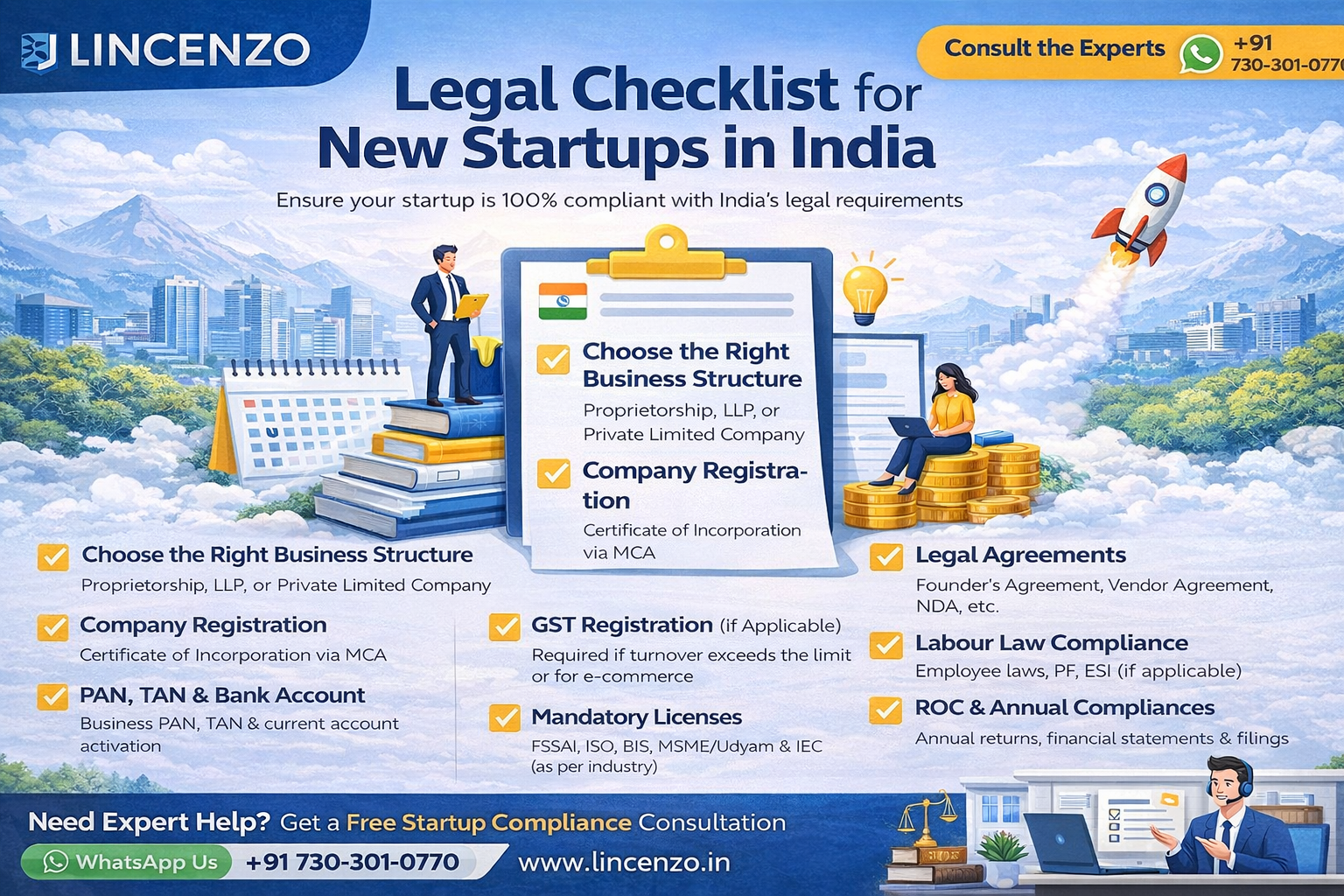
The first legal step is selecting the correct business structure. This decision impacts taxation, funding, compliance, and ownership.
Proprietorship – Small, individual-run businesses
LLP (Limited Liability Partnership) – Service startups, consultants
Private Limited Company – Startups planning to scale or raise funds
Wrong structure = higher taxes or compliance burden
Investors prefer Private Limited companies
Liability protection depends on structure
✔️ Checklist item: Business structure registered with proper documents.
Once the structure is chosen, formal registration is mandatory.
Certificate of Incorporation
PAN & TAN of the company
MOA & AOA (for companies)
Without proper registration:
You cannot open a current account
You cannot sign legal contracts
The business has no legal identity
✔️ Checklist item: Company legally incorporated with MCA.
Every startup must have:
PAN – For taxation
TAN – For TDS compliance
Current Bank Account – For business transactions
Using a personal bank account for business is a common mistake and can cause serious compliance issues later.
✔️ Checklist item: Business PAN, TAN & current account activated.
GST registration is mandatory if:
Turnover crosses the threshold limit
You sell on e-commerce platforms
You provide inter-state services
Many startups delay GST to “avoid compliance,” but this leads to penalties later.
Late registration
Wrong category selection
Not filing returns regularly
✔️ Checklist item: GST registration completed (if applicable).
Depending on the nature of your startup, additional licenses may be required.
FSSAI License – Food & beverage startups
BIS Certification – Electronics, toys, consumer products
ISO Certification – Quality & tender requirements
IEC (Import Export Code) – Import/export businesses
MSME / Udyam Registration – To avail benefits & subsidies
Running a business without required licenses is illegal—even if revenue is low.
✔️ Checklist item: Industry-specific licenses obtained.
Startup India registration offers:
Tax exemptions
Government recognition
Easier compliance norms
Access to funding & tenders
While optional, it is highly beneficial for early-stage startups.
✔️ Checklist item: Startup India registration completed (if eligible).
One of the most ignored items in a legal checklist for new startups in India is documentation.
Founder’s Agreement
Client / Service Agreement
Vendor Agreement
Employment or Freelancer Agreement
NDA (Non-Disclosure Agreement)
Verbal commitments or WhatsApp chats are not legally enforceable.
✔️ Checklist item: All key agreements drafted & signed.
If your startup hires employees, you must comply with labour laws.
Appointment letters
Salary structure & payslips
PF & ESIC (if applicable)
HR policies
Ignoring labour compliance can result in disputes and penalties.
✔️ Checklist item: Employee compliance & HR documentation in place.
For LLPs and companies, annual filings are mandatory even if there is no profit.
Annual returns
Financial statements
Director disclosures
Non-compliance can lead to:
Heavy late fees
Director disqualification
Company marked “non-compliant”
✔️ Checklist item: Compliance calendar set for annual filings.
Your brand is one of your most valuable assets.
Brand name (Trademark)
Logo & tagline
Website content
Without IP protection, competitors can legally copy your brand.
✔️ Checklist item: Trademark & IP protection initiated.
Many founders see compliance as a burden. In reality, it is a growth enabler.
A startup that follows a proper legal checklist for new startups in India:
Gains investor trust
Scales without legal hurdles
Avoids penalties & stress
Builds long-term credibility
Compliance done early is always cheaper than fixing mistakes later.
Lincenzo Private Limited provides end-to-end legal and compliance support for startups, including:
Business registration
GST, FSSAI, BIS, ISO & MSME
Startup India registration
Ongoing compliance management
We make compliance simple, affordable, and stress-free, so founders can focus on building their business.
📞 Get a free startup compliance consultation today.
We are India’s trusted business service provider, helping entrepreneurs and companies with registrations, licenses, compliance, and certifications. From startup to scale-up, we ensure hassle-free, fast, and reliable solutions for all your business needs.
Serving Partners

Quick Links
Services
Payment Methods
Get In Touch
Lincenzo Private Limited
Mon - Sat: 10:00 AM - 06:45 PM
Sunday : Closed
Need Help? Contact Us

Lincenzo Private Limited All Right Reserved | Privacy Policy
Rated at 4.9 By 43034 + Customers Globally