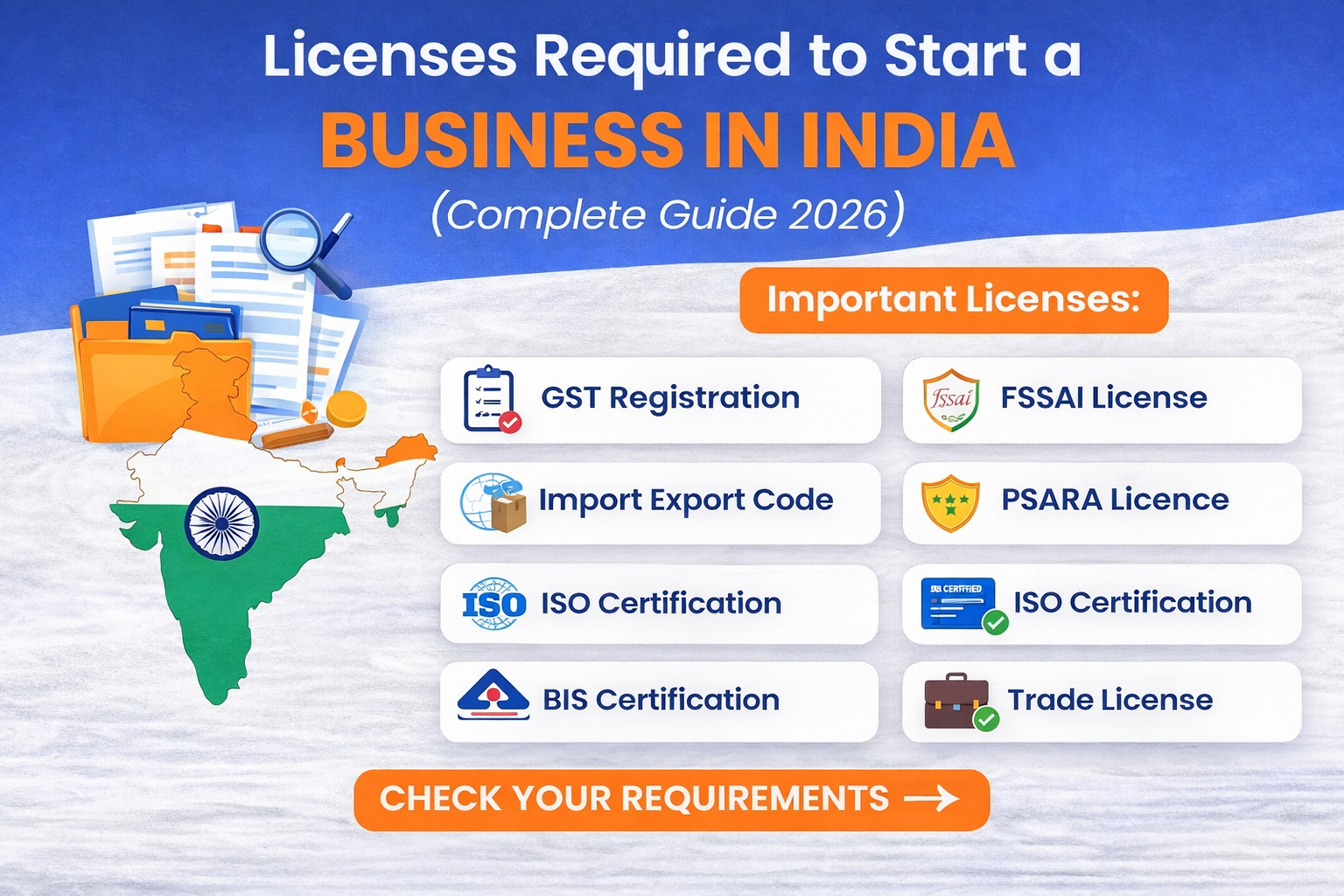
Licenses Required to Start a Business in India (Complete Guide 2026)
Starting a business in India is an exciting opportunity, but before launching operations, it is essential to obtain the required licenses and registrations. Proper compliance not only ensures legal operation but also builds trust with customers, investors, and government authorities. The licenses required depend on your business type, industry, location, and scale of operations. In this guide, we will explain the major licenses required to start a business in India and why they are important.

Rated at 4.9 By 43034 + Customers Globally
Certification & Licensing
Trademark
Startup
Income Tax
Compliance
Certification & Licensing
Trademark
Startup
Income Tax
Compliance
Certification & Licensing
Trademark
Startup
Income Tax
Compliance
Certification & Licensing
Trademark
Startup
Income Tax
Compliance
Obtaining the correct licenses offers several benefits:
Legal protection and compliance
Increased credibility and trust
Eligibility for government tenders and contracts
Access to loans and funding opportunities
Avoidance of penalties and legal complications
Operating without mandatory licenses can result in heavy fines or even closure of your business Legal Requirements to Start a Business in India.
Regardless of the industry, some registrations are common for most businesses in India.
The first step is registering your business entity. You can choose from:
Private Limited Company
Limited Liability Partnership (LLP)
One Person Company (OPC)
Partnership Firm
Sole Proprietorship
This registration provides legal identity to your business.
Permanent Account Number (PAN) is mandatory for tax purposes. TAN is required if your business deducts tax at source (TDS).
GST (Goods and Services Tax) registration is required if:
Annual turnover exceeds the prescribed limit
You sell goods or services across states
You operate an e-commerce business
GST allows businesses to collect and pay indirect taxes legally.
This license is issued by the state government and is required for businesses operating from a physical location such as offices, shops, or commercial establishments Legal Requirements to Start a Business in India.
It regulates:
Working hours
Employee conditions
Wage policies
Certain businesses require specialized approvals depending on the sector.
MSME registration is not mandatory but highly recommended. It provides:
Government subsidies
Loan benefits
Tax advantages
Tender participation benefits
Small and medium enterprises can significantly benefit from this registration.
If your business involves food manufacturing, processing, packaging, or selling, you must obtain an FSSAI license from the Food Safety and Standards Authority of India.
Examples:
Restaurants
Cloud kitchens
Food manufacturing units
Grocery stores
A trade license is issued by the local municipal authority and allows businesses to operate legally within a particular area.
It ensures that your business does not cause health hazards or nuisance to the public Legal Requirements to Start a Business in India.
Professional tax is applicable in certain states and must be paid by employers and employees engaged in professions or businesses.
If you plan to import or export goods or services, you must obtain an IEC license from the Directorate General of Foreign Trade (DGFT).
Manufacturing units or businesses that impact the environment may require approval from the Pollution Control Board.
This includes:
Factory setup
Industrial production
Chemical manufacturing
Some industries require additional compliance certifications.
ISO certification is not mandatory but enhances credibility and quality standards. It is often required for government tenders and international business opportunities.
Common ISO certifications:
ISO 9001 (Quality Management)
ISO 14001 (Environmental Management)
ISO 45001 (Safety Management)
Bureau of Indian Standards (BIS) certification is mandatory for certain products such as electronics, appliances, and industrial goods to ensure quality and safety standards.
If you want to start a private security agency, you must obtain a PSARA license under the Private Security Agencies Regulation Act.
Without PSARA approval, operating a security agency is illegal.
Startups can apply for DPIIT recognition under Startup India to receive:
Tax exemptions
Funding support
Government benefits
Compliance relaxations
Depending on your business activities, you may also need:
Fire Safety NOC
Labour License
Health License
Factory License
Drug License
Telecom or IT Certifications
The exact requirements vary depending on the industry and state regulations.
To determine the required licenses:
Identify your business activity
Decide your business structure
Check state-specific regulations
Consult compliance experts
Apply through the correct government authority
Professional guidance can help avoid delays and errors.
Many entrepreneurs face problems due to:
Starting operations without licenses
Choosing the wrong business structure
Missing mandatory registrations
Incorrect documentation
Ignoring state regulations
Planning compliance from the beginning ensures smooth business growth.
The timeline varies depending on the license type:
Company registration: 5–10 days
GST registration: 3–7 days
Trade license: 7–15 days
Industry certifications: 15–45 days
Proper documentation speeds up approval.
Starting a business in India requires multiple licenses and registrations depending on your industry and operations. From company formation and GST registration to industry-specific approvals like FSSAI, PSARA, or BIS, each license plays a crucial role in ensuring legal compliance and business credibility Legal Requirements to Start a Business in India.
Obtaining the right licenses at the right time helps businesses grow smoothly without legal complications.
If you are planning to start a business in India, consulting compliance professionals can simplify the entire process and ensure faster approvals Legal Requirements to Start a Business in India.
We are India’s trusted business service provider, helping entrepreneurs and companies with registrations, licenses, compliance, and certifications. From startup to scale-up, we ensure hassle-free, fast, and reliable solutions for all your business needs.
Serving Partners

Quick Links
Services
Payment Methods
Get In Touch
Lincenzo Private Limited
Mon - Sat: 10:00 AM - 06:45 PM
Sunday : Closed
Need Help? Contact Us
Lincenzo Private Limited All Right Reserved | Privacy Policy
Rated at 4.9 By 43034 + Customers Globally