Startup India Registration Benefits: Complete Guide for Indian Entrepreneurs (2026)
For manufacturers and businesses selling products in India, meeting applicable quality and safety requirements is an important part of building a compliant and trusted business. BIS certification plays a major role in this area by helping demonstrate that products conform to relevant Indian Standards.
Certification & Licensing
Trademark
Startup
Income Tax
Compliance
Certification & Licensing
Trademark
Startup
Income Tax
Compliance
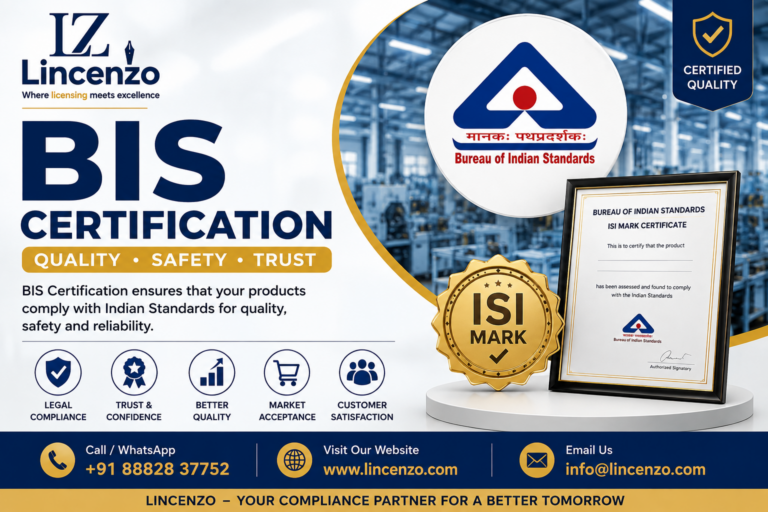
BIS certification is a conformity assessment mechanism through which eligible products are assessed against applicable Indian Standards. For products covered under the BIS Product Certification Scheme, a manufacturer may be granted a licence to use the relevant BIS Standard Mark after meeting the required conditions.
The Standard Mark indicates that the certified product conforms to the applicable Indian Standard within the scope of the licence. BIS also carries out surveillance activities during the operation of certification to help maintain conformity.
It is important to understand that BIS certification is not automatically mandatory for every product. The BIS scheme is generally voluntary, but the Government of India can make compliance compulsory for specified products through Quality Control Orders (QCOs).
Quality, safety, and regulatory compliance can have a direct impact on a product’s acceptance in the market. Certification can provide several advantages to manufacturers and businesses.
Certification provides evidence that the product has been assessed against the applicable Indian Standard and meets the specified requirements within the certification scope.
A recognised Standard Mark can give customers greater confidence regarding the quality and safety of applicable products.
For products covered by mandatory QCOs, obtaining the required BIS approval is a regulatory requirement. Businesses should therefore check the latest applicable notification before manufacturing, importing, selling, or distributing a regulated product.
Compliance with applicable standards can make it easier for manufacturers to establish credibility with buyers, distributors, institutions, and other business partners.
The certification process requires manufacturers to maintain suitable manufacturing infrastructure, process controls, quality-control arrangements, and testing capabilities relevant to the applicable standard.
There is no single rule stating that every product requires certification. The requirement depends on the product category, applicable Indian Standard, and government notifications.
BIS maintains a list of products under compulsory certification. These products can fall under different conformity-assessment schemes, including Scheme I, Scheme II, Scheme IV, and Scheme X.
For example, certain categories of products such as specific electrical equipment, construction-related products, and other regulated goods may be subject to compulsory requirements.
Because Quality Control Orders can be introduced, amended, or updated, manufacturers should verify the current requirement for their particular product rather than relying on an old list.
Although the exact requirements vary by product, a typical product certification process involves several important stages.
The first step is determining which Indian Standard applies to the product.
BIS advises manufacturers to identify the relevant standard before beginning the application process. Product-specific manuals can also provide information about testing, equipment, inspection, and other technical requirements.
The manufacturer needs appropriate infrastructure, process controls, quality-control systems, and testing capabilities corresponding to the applicable standard.
This stage is important because certification is not simply an application-based approval. The manufacturing capability and conformity of the product are also assessed.
Testing is an important part of the conformity assessment process. Depending on the applicable scheme and product, testing may involve a BIS-recognised laboratory, testing at the manufacturing premises, or a combination of methods.
The objective is to establish whether the product meets the requirements of the relevant Indian Standard.
BIS may assess the manufacturing premises to verify manufacturing infrastructure, process controls, quality-control arrangements, and testing capabilities.
The assessment helps determine whether the manufacturer can consistently produce products conforming to the applicable requirements.
Applications for product certification are submitted online through the BIS system. Manufacturers should ensure that the application and supporting information are complete and accurate to avoid unnecessary delays.
Once the required assessment and testing requirements are successfully completed, BIS can grant the licence under the applicable certification scheme.
The manufacturer can then use the relevant Standard Mark according to the conditions and scope of the licence.
The exact documentation depends on the product and applicable scheme. Requirements may include information relating to:
Because requirements differ between products, it is better to prepare documents according to the relevant BIS product manual rather than using a generic checklist. BIS provides product-specific technical manuals and guidance for applicants.
There is no single fixed price for all BIS certifications.
The total cost can depend on the product, applicable scheme, testing requirements, inspection, licence-related charges, and product-specific marking fees.
BIS’s published information lists an application fee of ₹1,000 and an inspection fee of ₹7,000 per man-day for the relevant product certification process, while annual licence and product-specific marking fees also apply. Applicants should verify the latest official fee schedule because charges and requirements can change.
Therefore, businesses should avoid assuming that every product will have the same certification cost.
The timeline depends on the certification route, product, testing requirements, inspection arrangements, and completeness of the application.
According to BIS, the average time for granting a licence under one option is generally around one month, while another route may take around four months from receipt and recording of a complete application. Actual timelines can vary due to queries, inspections, sample testing, fee payments, and other factors.
Obtaining approval is not necessarily the end of the compliance process.
BIS can conduct surveillance activities during the operation of a licence. These may include factory surveillance and testing of products collected from manufacturing premises or the market.
Manufacturers must continue to comply with the applicable requirements and conditions of their licence.
The Scheme of Inspection and Testing can also specify requirements concerning product marking, control units, testing frequency, sample quantities, acceptance criteria, and other production controls.
Businesses applying for certification should avoid:
Careful preparation can reduce delays and make the overall process more efficient.
BIS certification is an important compliance and quality-assurance mechanism for manufacturers whose products fall under applicable BIS requirements. It can help demonstrate conformity with Indian Standards, improve consumer confidence, and support regulatory compliance.
However, the requirements are product-specific. Before applying, manufacturers should identify the correct Indian Standard, check whether a QCO makes certification compulsory, review the relevant product manual, prepare the required infrastructure and documentation, and understand the testing and assessment requirements.
For businesses planning to apply, professional assistance can also help with understanding the applicable requirements, preparing documentation, coordinating the application process, and avoiding common procedural mistakes.
Looking for assistance with BIS certification? Lincenzo can help businesses understand the applicable process and documentation requirements for their products.
Lincenzo is a trusted business compliance and legal services platform, helping startups, MSMEs, and enterprises simplify registrations, certifications, licenses, and regulatory compliance with expert guidance and end-to-end support.