
The Business Registration Trap: Choosing a Structure Just Because It Is Cheap
A new business usually starts with excitement, not paperwork. You have an idea, maybe a product, a few potential customers, and a rough plan for how you want to make money. Then someone tells you that you need to register the business. That is often the moment the price comparison begins. One registration costs less. Another needs more documentation. A third option looks more formal but seems expensive. For a founder who is watching every rupee, the cheapest route can feel like the obvious winner. But there is something easy to miss here: a business structure is not a shopping item where the lowest price automatically means the best deal. The structure you choose can affect how your business is owned, managed, documented and expanded later. So before choosing a registration simply because it is cheaper, it is worth asking whether that option actually matches the business you are trying to create.
Certification & Licensing
Trademark
Startup
Income Tax
Compliance
Certification & Licensing
Trademark
Startup
Income Tax
Compliance
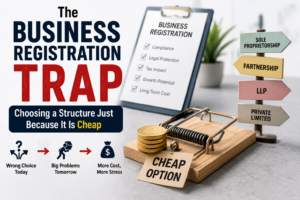
There is nothing unusual about wanting to reduce startup expenses.
A new entrepreneur may already have to pay for a website, branding, equipment, software, advertising, stock, rent, transport or professional services. Business registration becomes just one more expense on a long list.
This often creates a simple thought:
“Why should I pay more when I can start for less?”
The answer is not that everyone should choose an expensive structure.
The real issue is that the lowest upfront cost does not tell you what the business may need later.
A structure that fits a small solo operation may feel very different when the same business starts dealing with larger clients, new owners, employees or expansion plans.
Instead of looking only at today, try a small exercise.
Imagine that twelve months have passed.
Your customer list has grown. You are making more transactions. Someone has approached you about joining the business. You are discussing a large corporate contract. You may even be considering investment or entering another market.
Now look back at the registration choice you made on day one.
Would it still feel suitable?
There is no way to predict every future event, of course. But a basic growth picture can help you avoid making a decision that is based entirely on the current size of your business Registration.
When entrepreneurs compare structures, they often compare the initial registration expense and stop there.
That leaves out the rest of the journey.
Depending on the chosen structure and the nature of the business, there may be continuing requirements related to accounting, tax, records, filings and other compliance matters. Later, a business may also need changes in Business Registration ownership, restructuring or additional professional work.
This means the total cost of a structure is not necessarily the amount paid when the registration is first completed.
A cheaper beginning can sometimes be perfectly sensible.
But it can also create extra work later if the business outgrows the setup.
One of the first questions to ask is surprisingly simple:
Who is actually going to own the business?
If you are starting alone, your options may differ from a situation where two or more people are building the business together.
Now add another question:
Could someone else become an owner later?
A founder may start alone and later bring Business Registration in a sibling, business partner or investor. Another entrepreneur may have no such plan.
Neither approach is automatically better.
What matters is whether the chosen structure makes sense for the ownership arrangement you expect.
The registration decision can look very different at different stages.
A person offering freelance design services may value simplicity above everything else.
A small trading business may care about operational requirements and commercial relationships.
A startup developing a scalable product may be thinking about investment, formal ownership Business Registration and long-term expansion.
All three are businesses.
But they are not the same business.
That is why copying a friend’s registration choice is not always a useful shortcut.
Your friend’s business structure was selected for a particular situation. Yours should be evaluated according to your own plans.
Many small businesses start with individual customers.
Later, they begin approaching companies, institutions, distributors or larger vendors.
That can change the paperwork conversation.
A corporate onboarding process may ask for business registration information, tax details, banking records, ownership information, licences, certifications Business Registration or other documents depending on the type of relationship.
This does not mean that choosing a particular legal structure guarantees a contract.
It simply means that entrepreneurs should think about the type of commercial environment they want to enter.
If your business plan includes larger organizations, it makes sense to consider that when setting up the business.
Another common mistake is assuming that the most complicated setup must be the best one.
That is not true either.
A structure should not be chosen just because it sounds more impressive.
Overcomplicating a small business can create unnecessary administrative work and expense.
The goal is not to choose the most expensive structure.
The goal is to avoid choosing a structure without understanding why it fits.
A simple business can have a simple structure.
A growing business may need something different.
The answer depends on the situation.
This is another area where cost-focused decisions can become incomplete.
Different legal structures can provide different arrangements regarding the relationship between the business and its owners. The practical implications can depend on the structure, contracts, activities and applicable law.
Consider a business that sells physical products, signs significant agreements or handles customer information.
The founder should understand the legal and financial exposure involved rather than looking only at registration charges.
This is one area where professional advice can be particularly useful.
Entrepreneurs sometimes begin the process by asking:
“Which structure will save me the most tax?”
That question may be relevant, but it should not stand alone.
Tax treatment depends on the business structure, income, activities and current rules. A structure that appears attractive from one tax angle may not necessarily be the most convenient overall choice.
A better approach is to consider taxation alongside ownership, compliance, administration, growth and business goals.
In other words, do not build the entire decision around one number.
Some founders deliberately choose a simple structure and intend to change it when the business becomes larger.
That can be a valid strategy in some situations.
The problem comes when it is used without considering the work involved.
By the time a business has grown, it may already have:
Any major structural change can therefore require careful planning.
It may still be completely manageable, but it should not be treated as though nothing changes when the structure changes.
Before you select a business structure, write down the answers to these questions:
1. Am I starting alone or with others?
2. What exactly will the business sell or provide?
3. Who are my expected customers?
4. Do I plan to remain small or grow aggressively?
5. Could I bring in another owner later?
6. Is outside investment a realistic possibility?
7. What level of ongoing compliance can I manage?
This exercise takes much less time than rebuilding your setup after a major change.
A business registration gives you a formal starting point, but it does not automatically complete every requirement your business may have.
Depending on the industry and activity, a business might later need licences, sector-specific approvals, tax registrations, certifications, trademark protection or other compliance measures.
That is why it helps to think about the business as a complete system rather than a single registration certificate.
The structure is one piece of the picture.
At Lincenzo, we assist entrepreneurs with business setup and compliance requirements, including:
The suitable registration route depends on factors such as ownership, business activity and future plans.
Getting those details clear before filing can make the decision much easier.
Saving money at the beginning of a business is sensible.
Choosing blindly because something is cheaper is not.
A lower registration cost may be exactly what one entrepreneur needs, while another business may need a different structure because its ownership, risk or growth plans are completely different.
So before you ask:
“Which registration is cheapest?”
ask:
“Which structure fits the business I want to run?”
That question can lead to a much better decision.
Your first registration does not need to be the most expensive one.
It simply needs to be chosen for the right reasons.
Lincenzo – Where Licensing Meets Excellence.

Lincenzo is a trusted business compliance and legal services platform, helping startups, MSMEs, and enterprises simplify registrations, certifications, licenses, and regulatory compliance with expert guidance and end-to-end support.