Which Business License Do You Need? Complete Compliance Checklist in India
Starting a business in India is exciting, but one wrong step in compliance can lead to penalties, delays, or even shutdowns. Many entrepreneurs focus on branding, marketing, and funding—but licenses and registrations are the real foundation of a legally strong business. This detailed guide will help you understand which business license you need, why it matters, and how to build a complete compliance checklist for your startup or company.

Rated at 4.9 By 43034 + Customers Globally
Certification & Licensing
Trademark
Startup
Income Tax
Compliance
Certification & Licensing
Trademark
Startup
Income Tax
Compliance
Certification & Licensing
Trademark
Startup
Income Tax
Compliance
Certification & Licensing
Trademark
Startup
Income Tax
Compliance
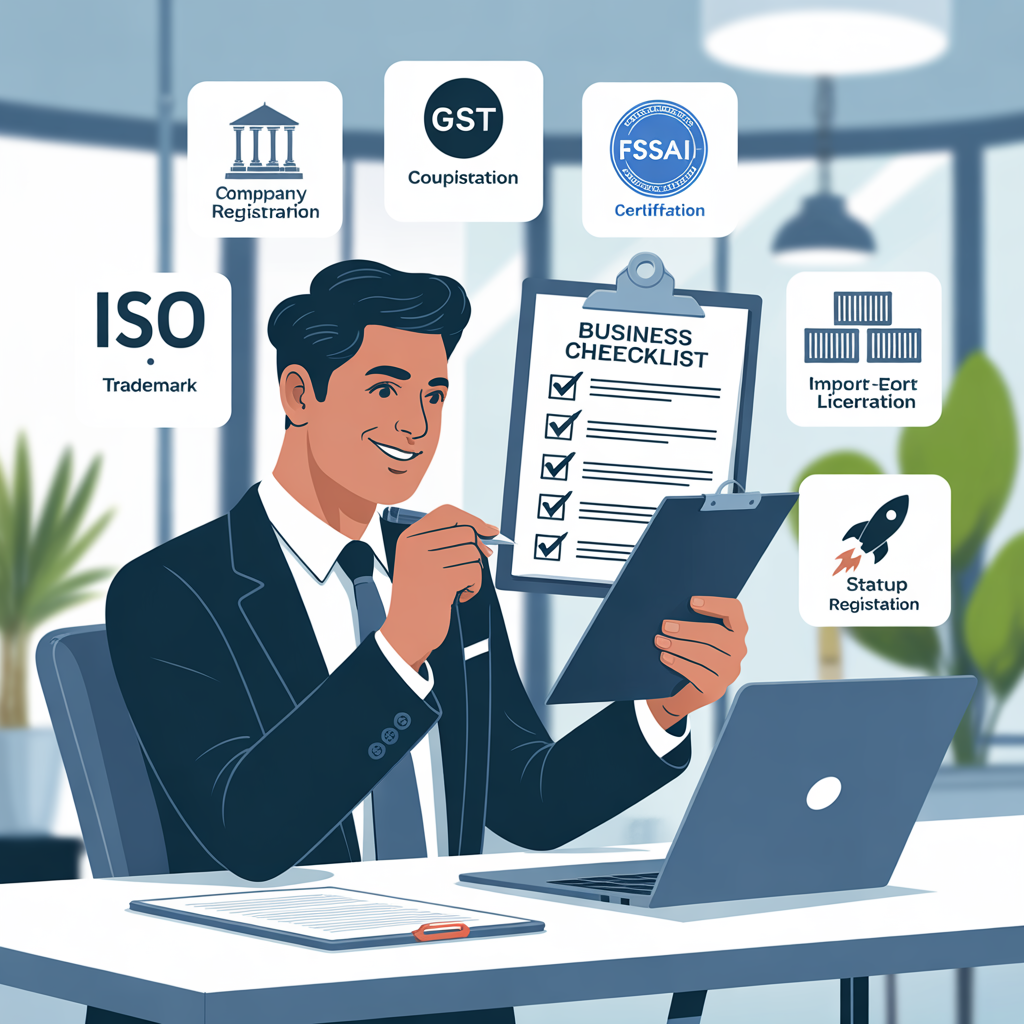
Business licenses are not just legal formalities. They:
Make your business legally valid
Build trust with customers, banks, and investors
Help you avoid government penalties and notices
Enable you to scale, raise funds, and apply for tenders
Different businesses require different licenses based on industry, turnover, location, and business structure.
Before applying for any license, your business must be registered under the correct structure:
Common Business Structures in India
Private Limited Company – Best for startups planning growth and funding
LLP (Limited Liability Partnership) – Ideal for professional services
Sole Proprietorship – Suitable for small businesses
Partnership Firm – For traditional partnerships
Why it matters:
Business registration gives you a legal identity, allows you to open a current bank account, sign contracts, and apply for GST and other licenses.
You need GST Registration if:
Your turnover exceeds the GST threshold
You sell goods/services online (Amazon, Flipkart, etc.)
You do interstate sales
You run a service-based business in many cases
Benefits of GST registration:
Legal tax collection
Input tax credit
Required for B2B clients and government work
This step depends entirely on what your business does.
Required if you:
Manufacture, distribute, store, or sell food
Run a restaurant, café, cloud kitchen, bakery, or food brand
Without FSSAI, food businesses can face heavy penalties or closure.
2. PSARA License (Security Agencies)
Mandatory for:
Private security agencies
Manpower security service providers
PSARA is state-specific and requires police verification and training compliance.
Required if you:
Import or export goods or services
Without IEC, customs clearance is not possible.
Required for:
Electronics, toys, helmets, steel products, and many imported goods
BIS certification ensures product safety and quality compliance.
Required for:
Newspapers
Magazines
Periodicals
Issued by the Registrar of Newspapers for India.
These certifications are not always mandatory, but they boost credibility and business growth.
Focuses on quality management
Builds customer trust
Often required for tenders and large clients
Focuses on data and information security
Important for IT, software, fintech, and data-driven businesses
If you have:
A brand name
Logo
Tagline
You should apply for Trademark Registration.
Why it matters:
Prevents brand copying
Gives you legal ownership
Adds value to your business
Required for marketplaces and investors
Recommended if:
You are a DPIIT-recognized startup
Benefits include:
Tax exemptions
Government schemes
Funding support
Easier compliance
Required if you want to:
Sell products or services to government departments
GeM opens doors to huge government tenders and contracts.
Depending on location, you may also need:
Shops & Establishment Registration
Professional Tax Registration
Local municipal licenses
These vary by state and city, but are equally important.
Use this checklist to stay compliant:
Business Registration (Pvt Ltd / LLP / Proprietorship)
✔ PAN & Current Bank Account
✔ GST Registration
✔ Industry-Specific License (FSSAI / PSARA / BIS / DGFT / RNI)
✔ Trademark Registration
✔ ISO Certification (if applicable)
✔ Startup India Registration
✔ GeM Portal Registration
✔ Local & State Registrations
Applying for the wrong license
Delaying GST registration
Ignoring trademark protection
Missing renewal deadlines
Not understanding state-wise rules
These mistakes can cost money, time, and reputation.
There is no single license that fits all businesses. The right compliance depends on:
Your business activity
Business structure
Location
Growth plans
Getting professional guidance ensures faster approvals, zero errors, and long-term peace of mind.
We are India’s trusted business service provider, helping entrepreneurs and companies with registrations, licenses, compliance, and certifications. From startup to scale-up, we ensure hassle-free, fast, and reliable solutions for all your business needs.
Serving Partners

Quick Links
Services
Payment Methods
Get In Touch
Lincenzo Private Limited
Mon - Sat: 10:00 AM - 06:45 PM
Sunday : Closed
Need Help? Contact Us

Lincenzo Private Limited All Right Reserved | Privacy Policy
Rated at 4.9 By 43034 + Customers Globally