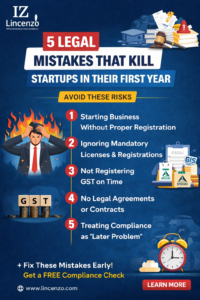
1. Starting the Business Without Proper Registration
startup legal mistakes Many founders begin operations without formally registering their business.
They think:
This is the most common and most expensive mistake.
What goes wrong?
You cannot legally sign contracts
Investors won’t take you seriously
You face problems opening current accounts
You are personally liable for losses and penalties
Common mistakes:
Running a Pvt Ltd business as a sole proprietor
No LLP or company registration
Using a personal bank account for business transactions
What you should do instead:
Choose the right structure from day one startup legal mistakes
Proprietorship – very small/local businesses
LLP – service startups, consultants
Private Limited – startups planning to scale or raise funds
👉 Early registration protects founders legally and financially.
2. Ignoring Mandatory Licenses and Registrations
This is where many startups unknowingly become illegal businesses.
Different businesses require different licenses, but founders often assume startup legal mistakes:
“I’ll apply only if someone asks.”
By the time someone asks, it’s usually a government notice.
Commonly ignored licenses:
GST Registration – for service providers, e-commerce sellers
FSSAI License – food, cloud kitchens, restaurants
BIS Certification – electronics, toys, consumer products
Import Export Code (IEC) – exporters/importers
MSME/Udyam Registration – missed benefits and subsidies
Real consequences:
Heavy penalties
Backdated compliance fees
Business operations halted
Listings removed from Amazon, Flipkart, Swiggy, Zomato
Reality check:
Licenses are not optional.
They are legal permissions to operate.
3. Not Registering GST on Time (or Doing It Wrong)
GST is one of the biggest compliance traps for startups.
Many founders delay GST registration to avoid:
Filing returns
Paying taxes
Compliance costs
This backfires badly.
Common GST mistakes:
Crossing turnover limit but not registering
Wrong GST category selected
No regular return filing
Using GST number without proper invoices
Ignoring GST notices
What happens next?
GST department issues notices
Late fees pile up
Bank accounts may get flagged
Business credibility drops instantly
Pro tip:
Even if you are making low revenue, GST planning from day one saves massive trouble later startup legal mistakes.
4. No Legal Agreements or Contracts
Startups often run on verbal commitments, WhatsApp messages, or trust.
This is extremely risky.
Where things go wrong:
Missing documents that cause damage:
One harsh truth:
If it’s not written and signed, it doesn’t exist legally.
Startups collapse not because of lack of work, but because of uncontrolled disputes that could have been avoided with basic documentation startup legal mistakes.
5. Treating Compliance as “Later Problem”
This mindset kills startups silently.
Founders focus on:
And ignore:
Annual filings
Tax returns
License renewals
ROC compliance
Statutory deadlines
What happens over time?
Example:
A startup that ignores annual filings for 2–3 years may have to pay ₹50,000–₹2,00,000+ just to become compliant again.
Smart founders do this:
Set up compliance calendars
Outsource compliance to experts
Treat legal health like financial health
Final Thoughts: Compliance Is Not a Burden — It’s Protection
Most founders think legal work slows growth.
In reality:
Legal compliance enables growth.
A compliant startup:
The startups that survive and scale are not the ones who ignore rules —
they are the ones who fix compliance early.
How Lincenzo Helps Startups Stay Safe
Lincenzo Private Limited helps startups and businesses with:
Business registration (Pvt Ltd, LLP, Proprietorship)
GST Registration & Compliance
FSSAI, BIS, ISO, MSME, IEC
End-to-end legal and regulatory support
We make compliance simple, affordable, and stress-free, so founders can focus on what matters — building their business.
👉 If you’re a startup founder, fix these mistakes before they cost you.
📞 Reach out for a free compliance check today.