Startup India Registration Benefits: Complete Guide for Indian Entrepreneurs (2026)
The private security industry in India has witnessed remarkable growth over the past decade. From residential societies and corporate offices to hospitals, educational institutions, malls, and industrial facilities, security agencies play a crucial role in ensuring public safety and asset protection. However, operating a security agency without the required legal authorization can result in penalties, loss of credibility, and even business closure. This is where the PSARA License becomes essential. Governed by the Private Security Agencies (Regulation) Act, 2005, a PSARA License is mandatory for any business offering private security services in India. It not only ensures legal compliance but also builds trust among clients and opens the door to larger business opportunities. In this guide, we'll explain why every security agency needs a PSARA License, its benefits, eligibility, required documents, and the registration process. If you're planning to launch a startup or have already started your business, obtaining Startup India Registration can help you access government schemes, funding opportunities, tax exemptions, and easier compliance. In this guide, we'll explain the benefits, eligibility criteria, required documents, registration process, and why Startup India recognition can be a valuable step for your business. LMPC Registration is a crucial legal compliance requirement under the Legal Metrology Act, 2009 and the Legal Metrology (Packaged Commodities) Rules, 2011. It helps ensure that packaged goods sold in India display accurate information such as quantity, MRP, manufacturer or importer details, and customer information. These rules are designed to protect consumers and promote fair trade practices. In this guide, you'll learn everything you need to know about LMPC Registration, including who needs it, required documents, fees, the registration process, and the benefits of compliance. In this simple guide, we will help you understand which license your business needs based on your industry and operations.

Rated at 4.9 By 43034 + Customers Globally
Certification & Licensing
Trademark
Startup
Income Tax
Compliance
Certification & Licensing
Trademark
Startup
Income Tax
Compliance
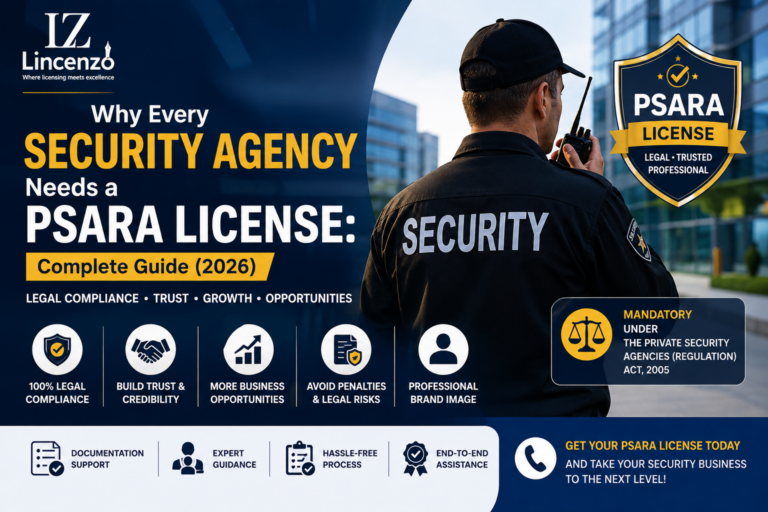
A PSARA License is a legal authorization issued by the respective State Government under the Private Security Agencies (Regulation) Act, 2005. It permits individuals or companies to operate a private security agency legally within a state or specified jurisdiction.
The Act was introduced to regulate the functioning of private security agencies, maintain professional standards, and ensure that security personnel are properly trained and verified before being deployed.
Operating a security agency without a PSARA License is not legally permitted in India. The license ensures that agencies comply with government regulations regarding employee verification, training standards, record maintenance, and operational procedures.
Whether you are planning to provide:
obtaining a PSARA License is an essential legal requirement.
A PSARA License ensures your business operates in accordance with Indian laws. It minimizes legal risks and helps your agency avoid penalties or operational restrictions.
Legal compliance also demonstrates professionalism and commitment to industry standards.
Clients prefer licensed security agencies because they know the company has fulfilled government requirements.
A licensed agency appears more reliable, trustworthy, and professional compared to an unregistered business.
This increased credibility often helps businesses secure long-term contracts.
Many government departments, public sector undertakings (PSUs), multinational companies, hospitals, airports, banks, and educational institutions require security service providers to possess a valid PSARA License.
Without one, your agency may not qualify for many high-value tenders and contracts.
A licensed security agency can confidently expand its operations by serving:
The license enhances your market reputation and helps attract more clients.
A PSARA License reflects professionalism and commitment to quality.
It reassures customers that your agency follows proper recruitment procedures, employee verification, and training standards.
A strong professional image also improves client retention and referrals.
The PSARA framework encourages agencies to maintain:
Proper documentation creates a well-organized workforce and improves operational efficiency.
Operating without the required approvals can expose a business to regulatory action and contractual challenges.
A valid PSARA License helps demonstrate compliance with applicable regulations and reduces the risk of legal complications arising from operating without authorization.
When customers compare multiple security agencies, a licensed company often stands out as a more dependable choice.
Having a PSARA License can provide a competitive edge, especially when bidding for commercial or institutional contracts.
A PSARA License is generally required for businesses providing private security services, including:
If your business supplies security personnel to clients, you should determine whether a PSARA License is required under the applicable state regulations.
While eligibility requirements may vary by state, applicants generally need to:
Applicants should review the latest state-specific requirements before applying.
Commonly required documents include:
Additional documents may be requested depending on the state.
Register your business under the appropriate legal structure.
Collect all required business and promoter documents.
Complete police verification and other checks required under applicable rules.
Meet the training requirements specified under the relevant state rules, including any required arrangements with approved training institutes.
Submit the application along with the required documents to the designated licensing authority.
The competent authority reviews the application and supporting documents. Upon successful verification and fulfillment of the applicable requirements, the PSARA License is issued.
Many applications face delays due to avoidable mistakes, including:
Proper preparation can help reduce delays.
Applying for a PSARA License involves documentation, coordination, and compliance with state-specific regulations. Professional assistance can simplify the process and reduce the likelihood of errors.
At Lincenzo, we provide:
Our team works to make the licensing process smoother so you can focus on growing your security business.
A PSARA License is more than a legal requirement—it is a valuable asset for any security agency looking to build credibility, attract larger clients, and operate confidently within the regulatory framework. From improving customer trust to qualifying for corporate and government opportunities, the license strengthens your agency’s foundation for long-term growth.
If you plan to start or expand a private security agency, obtaining a PSARA License should be one of your top priorities. Ensuring your application is complete and compliant with the applicable state requirements can help make the approval process more efficient and position your business for future success.

Lincenzo is a trusted business compliance and legal services platform, helping startups, MSMEs, and enterprises simplify registrations, certifications, licenses, and regulatory compliance with expert guidance and end-to-end support.